
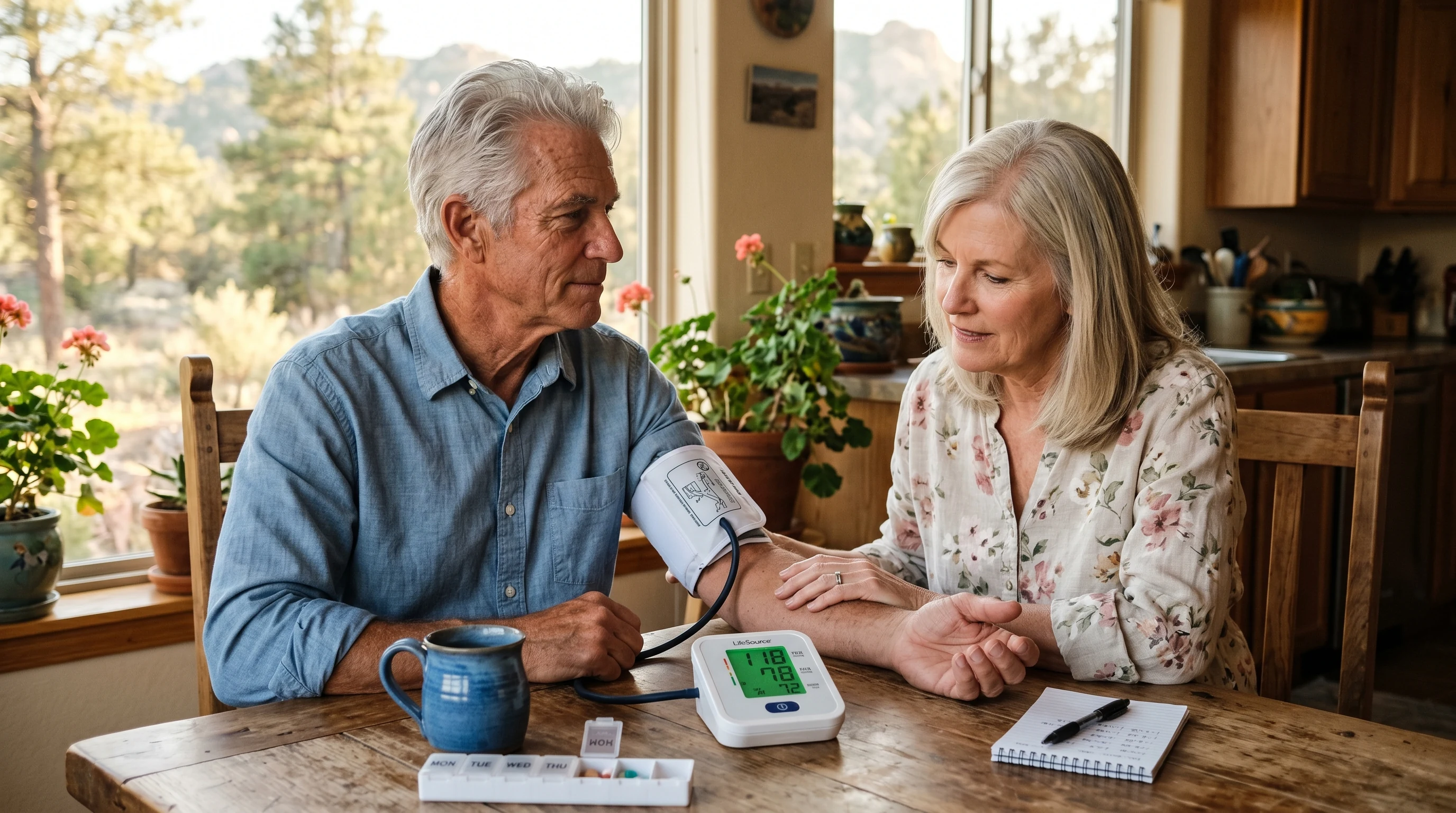
At 5,400 feet, Prescott qualifies as moderate altitude — and that affects your blood pressure. Healthy adults see daytime systolic pressure rise about 5 mmHg; hypertensive patients can see 8-11 mmHg increases. Here's what the research shows and how to manage BP at altitude.
If you moved to Prescott from sea level — California, Texas, Florida, the Gulf Coast — you may have noticed your blood pressure cuff started reading differently after you arrived. You're not imagining it. Living at 5,400 feet measurably changes how your cardiovascular system works.
The good news: for most people, the changes are modest and manageable. The harder news: if you have hypertension, take blood pressure medication, or have any cardiovascular history, altitude adds a layer of complexity worth understanding.
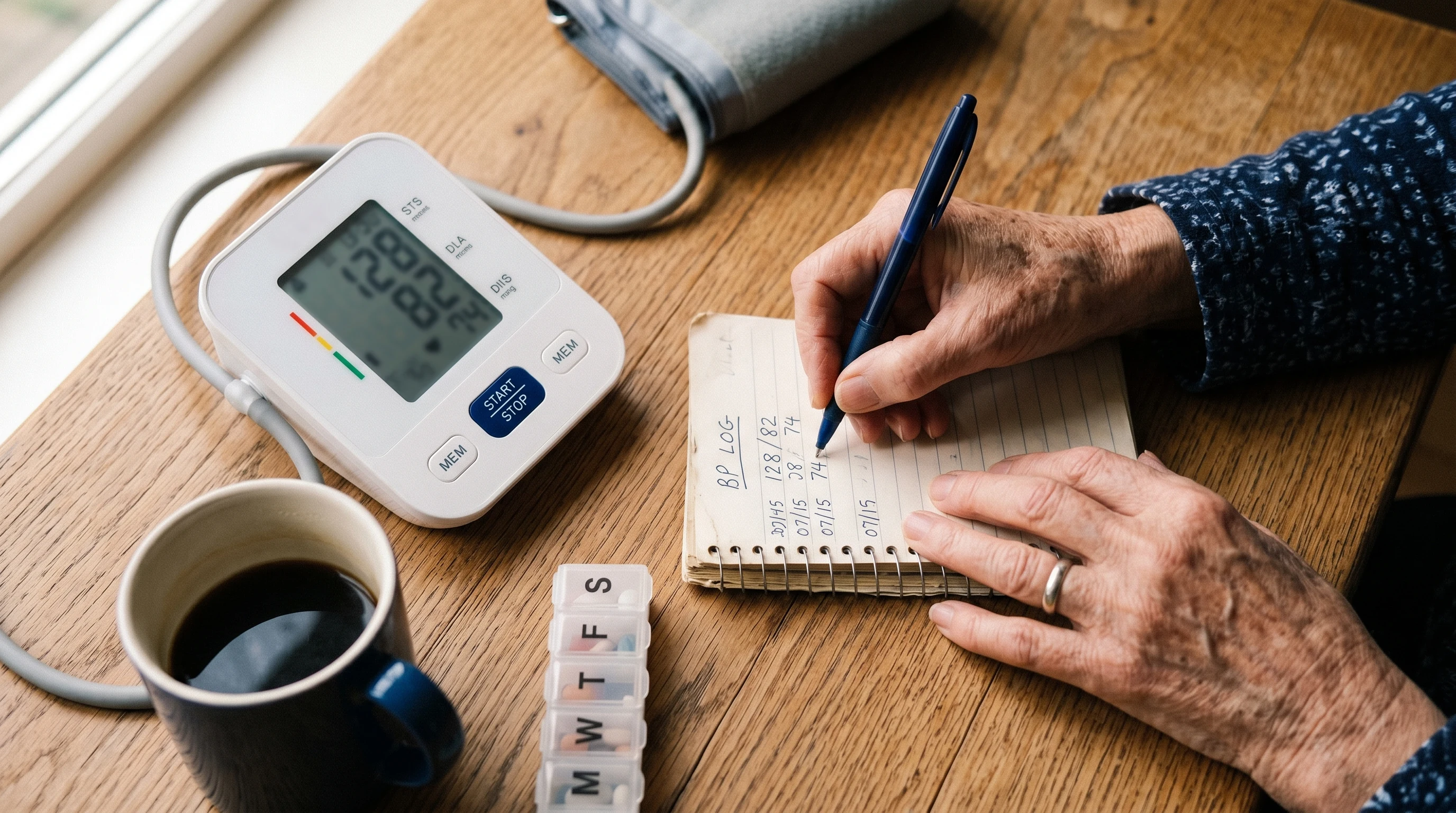
Here's what the peer-reviewed evidence actually says about blood pressure at Prescott's elevation, and what practical adjustments make sense.
Key Takeaways
- At moderate altitude, healthy adults see daytime systolic blood pressure rise an average of about 5 mmHg, with effects more pronounced after age 40 (International Journal of Cardiology, 2020)
- Hypertensive patients at altitude can see 24-hour systolic pressure increase 11.0 mmHg on placebo and 8.1 mmHg even on antihypertensive medication (AHA Hypertension, 2024)
- The 2025 AHA/ACC guideline maintains hypertension at ≥130/80 and emphasizes home/ambulatory measurement over single in-office readings (Circulation, 2025)
- U.S. adult hypertension prevalence is projected to rise from 51.2% (2020) to 61.0% by 2050 (AHA Heart Disease & Stroke Statistics, 2025)
Why Altitude Affects Blood Pressure
The physiology is well-established. As elevation rises, the partial pressure of oxygen in inhaled air falls. Your body senses lower oxygen and triggers a cascade: sympathetic nervous system activation, increased heart rate, vasoconstriction in some vascular beds, and over weeks to months, increased red blood cell production. The net effect on blood pressure depends on how strongly each mechanism kicks in for a given individual.

Prescott sits at 5,400 feet (1,646 meters). In the cardiology literature this qualifies as moderate altitude — high enough to produce measurable effects, but well below the "high altitude" threshold (above 8,200 ft) where effects become dramatic.
What the Research Actually Shows
The most directly relevant study for Prescott residents is Bilo and colleagues' research published in the International Journal of Cardiology. Looking at people moving to moderate altitude, they found:
- Daytime systolic blood pressure rose from 125.6 to 130.6 mmHg on average — about a 5 mmHg increase.
- Nighttime systolic blood pressure also rose roughly 5 mmHg.
- The effect was more pronounced in people over 40.
For hypertensive patients, the picture is more concerning. The HIGHCARE study published in AHA Hypertension took hypertensive volunteers to high altitude and found 24-hour systolic blood pressure increased 11.0 mmHg on placebo and 8.1 mmHg even on antihypertensive treatment. The take-home: medication helps, but doesn't completely neutralize the effect.
For exercise specifically, a related JACC paper from the HIGHCARE investigators found that exercise blood pressure response is exaggerated at altitude in hypertensive patients — meaning the spike during exertion is larger than it would be at sea level.
What About Long-Term Residents?
This is where the data gets interesting — and contradictory.
On one side: a 2024 BMC Public Health cohort study of 67,275 hypertensive adults (mean age 63.9) found that higher altitude residence was linked to increased all-cause and cardiovascular mortality, especially in older and rural patients.
On the other side: a U.S. county-level analysis by University of Colorado Anschutz and Harvard researchers found that 11 of the 20 highest-life-expectancy counties for men in the U.S. (mean elevation 5,967 ft) were in Colorado and Utah — with men living 1.2-3.6 years longer than sea-level peers. The effect attenuated when adjusted for socioeconomic factors, but didn't disappear.
How to reconcile these? My clinical read: long-term altitude residence appears protective for healthy people (probably through chronic mild hypoxic conditioning, lifestyle factors that correlate with mountain-town living, and improved insulin sensitivity), but adds cardiovascular stress for people who already have hypertension or heart disease. The same altitude isn't the same risk for every patient.
If You Just Moved to Prescott from Sea Level
This is one of the most common scenarios in my practice. A 65-year-old retires from San Diego, Tampa, or Houston, moves to Prescott, and within a few weeks notices their home BP readings have crept up.
What's typical: A 5-10 mmHg systolic increase during the first weeks at altitude, particularly in adults over 40. Most of the acute effect attenuates over weeks to months as the body acclimatizes. But some residual increase often persists.
What I recommend:
- Get a validated home BP cuff and start measuring twice daily for the first month. The 2025 AHA/ACC guidelines explicitly emphasize home measurement over single in-office readings — and we now have a baseline to track from.
- Don't adjust your own medications. If your numbers are higher than they used to be, call us. We may need to titrate. We may also need to do nothing — the body often adjusts.
- Hydrate carefully. Some BP medications (especially diuretics) work less predictably at altitude where dehydration is faster.
- Watch the cold months. Cold weather raises BP independently of altitude. Per Mayo Clinic, every 1°C drop in living-room temperature raises systolic BP about 1.3 mmHg in adults 65-74. Prescott winters are cold by Arizona standards. Indoor temperature matters.
If You Already Live Here and Have Hypertension
The basics of hypertension management are unchanged by altitude — but a few adjustments make sense:
- Track home readings. The 2025 AHA/ACC guideline strongly recommends home BP monitoring with validated upper-arm cuffs. Cuffless smartwatch BP devices are explicitly NOT recommended at this time. Bring your readings to visits.
- Time of day matters. Altitude tends to compress the normal nocturnal BP dip. If your readings are highest at bedtime, that's worth talking through.
- Be aware of polycythemia. Living at altitude can trigger excess red blood cell production. Cross-sectional Tibetan data shows high-altitude polycythemia prevalence around 25.8% in immigrants to altitude — though the effect is far milder at Prescott's elevation. We screen with a CBC.
- If you have sleep apnea, treat it. Per peer-reviewed analysis, OSA at altitude produces combined obstructive and central apneas, sympathetic surge, and elevated systolic BP. People who move from sea level often need their CPAP pressure recalibrated for altitude.
What's New in BP Care for 2025-2026?
The 2025 AHA/ACC High Blood Pressure Guideline introduced several practical changes worth knowing:
- Hypertension still defined as ≥130/80. No threshold change.
- The PREVENT risk equation replaces the older Pooled Cohort Equations for cardiovascular risk estimation. It accounts for kidney function and metabolic factors more accurately, and is now the preferred tool.
- Out-of-office measurement is preferred over single in-office readings for diagnosis. Home BP and 24-hour ambulatory monitoring carry more weight than they did in earlier guidelines.
- Cuffless smartwatch devices are not recommended for diagnosis or management. Validated upper-arm cuffs only.
Visiting Prescott from Lower Elevation
Patients sometimes ask whether they should worry about visiting family at altitude. For healthy people: usually not. For people with cardiovascular disease, severe COPD, sickle cell trait, or recent hospitalization — talk to your physician before the trip. Acute exposure to 5,400 feet causes the largest BP changes; if you have a hypertensive emergency or post-MI patient flying in for a wedding, that's worth a phone call before the plane lands.
Practical tips for visitors:
- Hydrate aggressively — start the day before the flight.
- Avoid alcohol the first 24-48 hours at altitude.
- Avoid strenuous activity (including hiking) for the first 1-2 days.
- Bring an extra week of any cardiovascular medications, in case the trip extends.
How We Manage BP in DPC
Hypertension is the textbook example of a condition that does badly in 7-minute insurance visits and well in Direct Primary Care. We can:
- Take 30+ minutes to review home BP logs and trends, not just the current reading.
- Adjust medications iteratively — sometimes weekly — instead of waiting three months between visits.
- Lend or recommend validated home cuffs and walk you through proper technique (most home readings are done wrong).
- Coordinate sleep studies, kidney function checks, and other workup when the picture isn't straightforward.
- Be reachable when something feels off — call, text, or email — without waiting for an appointment slot.
U.S. hypertension prevalence is projected to rise from 51.2% in 2020 to 61.0% by 2050 (2025 AHA Heart Disease and Stroke Statistics). The opportunity to manage this condition well — early, individually, with time to actually adjust — is exactly what our practice was built for.
When to Call Us
For our existing members: any home BP reading consistently above 140/90, sustained readings above 160/100, dizziness or lightheadedness on standing, severe headaches with elevated readings, or chest pain — call same-day. For BP above 180/120 with symptoms, call 911 or go to an ED.
If you're not yet a member and would like a primary care relationship that takes blood pressure management seriously, you can enroll here, learn more about our DPC model, or call 928-515-2803. The cuff matters. The numbers matter. So does having the time to do something with them.
Frequently Asked Questions
Does living at altitude raise blood pressure?
Yes, modestly. Peer-reviewed research at moderate altitude (similar to Prescott's 5,400 ft) shows healthy adults see daytime systolic blood pressure rise about 5 mmHg on average, with greater effect after age 40. For hypertensive patients, the HIGHCARE study found 24-hour systolic pressure increased 11.0 mmHg on placebo and 8.1 mmHg even on antihypertensive medication. Long-term residents often acclimatize partially but rarely fully.
I just moved to Prescott from sea level — should I worry about my BP?
Most healthy adults adjust within weeks to months. Get a validated home BP cuff and measure twice daily for the first month, then bring your log to your doctor. Don't adjust your own medications. Watch hydration carefully (some BP meds work differently at altitude). Cold winter weather adds an additional BP rise — about 1.3 mmHg systolic for every 1°C drop in indoor temperature in adults 65-74.
What's the current definition of high blood pressure?
The 2025 AHA/ACC guideline maintains hypertension at ≥130/80 mmHg — same as the 2017 guideline. What's new in 2025 is the strong emphasis on home or 24-hour ambulatory monitoring over single in-office readings, the use of the PREVENT risk equation for cardiovascular risk estimation, and an explicit recommendation against using cuffless smartwatch BP devices for diagnosis or management.
Are smartwatch blood pressure features accurate?
No — and the 2025 AHA/ACC guideline specifically advises against relying on cuffless smartwatch BP devices for diagnosis or management. Validated upper-arm cuffs remain the standard. Wrist cuffs are also less reliable than upper-arm cuffs. The American Medical Association maintains a list of validated devices at validatebp.org.
Should I avoid visiting Prescott if I have heart disease?
Most people with stable heart disease do fine at Prescott's elevation, but it's worth a conversation with your cardiologist before the trip — especially if you've had a recent cardiovascular event, have severe COPD, sickle cell trait, or unstable angina. Hydrate the day before flying, avoid alcohol and strenuous activity for the first 24-48 hours, and bring an extra week of any cardiovascular medications. Acute exposure produces the largest BP changes.