
In a wide-ranging interview on the Life's Best Medicine podcast, Dr. Price sat down with longtime friend and physician Dr. Brian Lenzkes to talk about why she walked away from corporate medicine, what Direct Primary Care actually looks like in practice, and the partnership that's now growing at our Prescott office.
In May 2024, Dr. Deanna Price sat down with her longtime friend and fellow internal medicine physician Dr. Brian Lenzkes for an episode of the Life's Best Medicine podcast. The conversation became the most candid public account of why Prescott Professional Healthcare exists at all — what was broken in the system she left, what Direct Primary Care actually looks like day to day, and the partnership that's now growing inside our Prescott office.
What follows is drawn from that conversation, in Dr. Price's own words. The full episode is embedded below if you'd rather listen.
Key Takeaways
- Dr. Price practiced internal medicine for 15 years in San Diego before relocating to Prescott in 2015.
- She left a corporate-owned practice in 2024 because the system was "imploding" — Medicare-driven box-checking had replaced actual patient care.
- Her old patients used to wait six to nine months for a physical. The average U.S. primary-care visit lasts under 19 minutes (JAMA Health Forum, 2023). At PPHC, visits are unhurried and same-day appointments are the norm.
- She founded PPHC with Jennifer Carter — her medical assistant, best friend, and now business partner — and was joined by Dr. Brian Lenzkes shortly after launch.
- What's coming to the Prescott office: cooking classes, group hikes with patients, IV hydration, and a relaxation room.
Why She Left Corporate Medicine
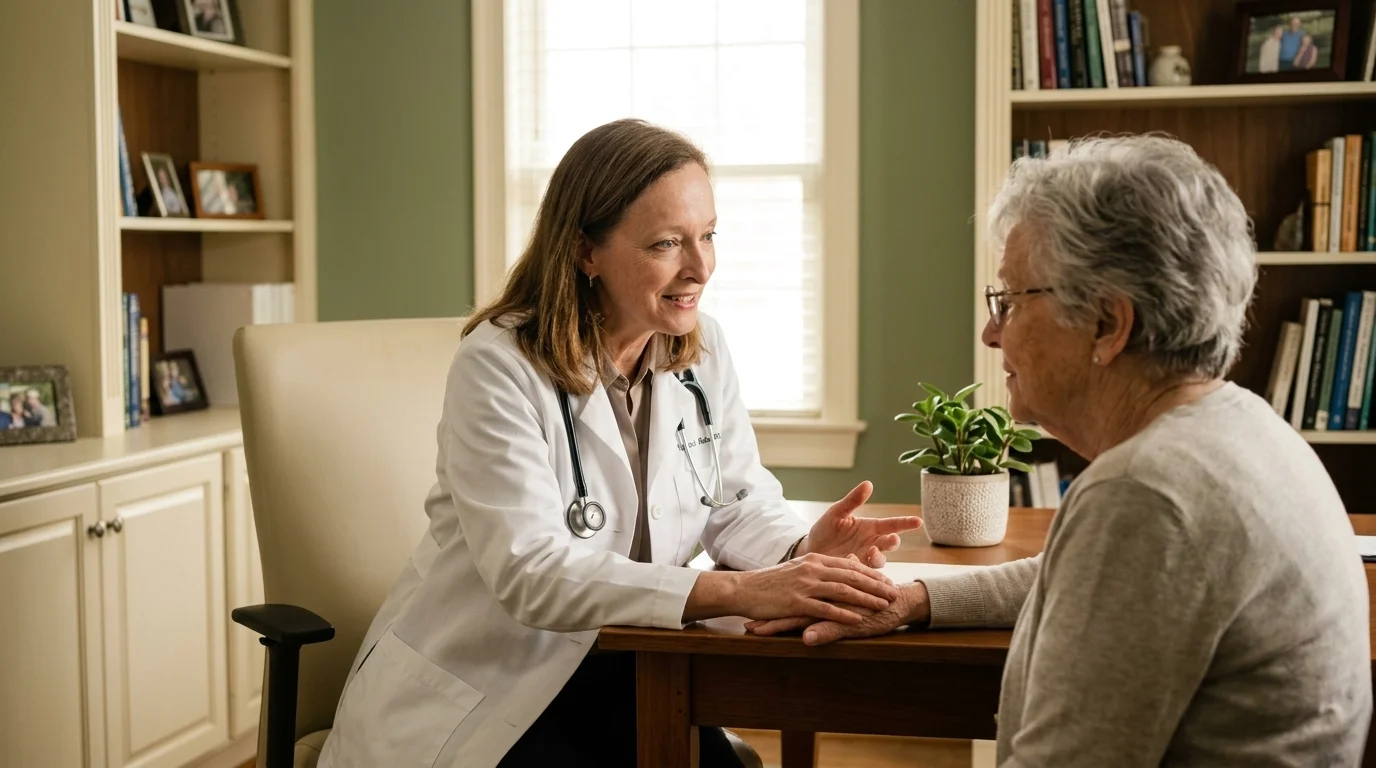
Dr. Price spent 15 years in a five-physician group practice in San Diego before relocating to Prescott in 2015. She joined a local medical group that, in her words, "was taken over by what's happening in medicine now" — large corporations buying up independent practices, then optimizing them for Medicare reimbursement rather than patient care.
"Medicare now that they can see what we're doing with these electronic medical records is now demanding certain things we put in the records," she told Dr. Lenzkes. "And if it's not put there then you don't get paid. If it's put there you get paid. So then corporations started taking over and of course they're not quite as dedicated to the patient as they are to the money."
The breaking point came with how Medicare's Annual Wellness Visit (AWV) was structured. Per CMS's official AWV guidance, "the AWV isn't a head-to-toe physical exam" — and any problem-focused care provided during the same visit must be billed separately. In practice, that meant physicians weren't supposed to address actual medical concerns during the appointment most older adults rely on. "It's absolutely ridiculous," Dr. Price said. "The patients think it's ridiculous."
What She Saw in the System She Left
Three things drove the decision:

The wait times. "Physicals — golly, I would book six, nine months. I would tell people, book your physical today for next year." Specialists were even worse. A cardiologist she'd known for years told her: "Brian, I have nowhere to put them. Nowhere. I'm booked out for three months." These wait times aren't an outlier — the AAMC projects a U.S. shortage of up to 86,000 physicians by 2036, including 20,200–40,400 primary care physicians. Half the providers in Prescott, Dr. Price noted, are now nurse practitioners or physician assistants rather than MDs or DOs.
The depersonalization. She compared the experience of corporate medicine to an oversold flight at the airport — "this chaos all the time" — instead of the personal-touch primary care she and Dr. Lenzkes had tried to practice inside the system.
The fragmented care. She recounted a story from a Prescott neighbor who went to the ER with a urinary infection, another problem, and a knee injury. The ER's response: "Which one do you want to deal with today? You have to come back. You can't deal with all of them."
"You don't take your car that's not running and say, well, we'll fix the alternator today and we'll fix the engine next week," Dr. Price said. "One of the benefits of Direct Primary Care is that we have time to really look at all the problems."
What Direct Primary Care Actually Looks Like
Two weeks into running her own DPC practice at the time of the interview, Dr. Price described what had already changed. The structural piece is simple: a 2024 AAFP data brief reports that DPC physicians carry patient panels roughly one-third the size of traditional primary-care doctors (about 413 patients on average vs. 1,200–1,500 in fee-for-service). Smaller panels are what make everything else possible.
What that looks like in practice:
- The waiting room isn't a waiting room. "We get to decorate the way we want to. It's not a sterile waiting room — it looks more like a living room. We have some soft music playing, and we're serving some decaffeinated coffee."
- Same-day access is real. "I had a patient come in and say, 'Can I schedule an appointment? I got this thing on my hand.' I didn't have anybody at the moment. I said, just come on in."
- You can do five physicals a year. "It's covered." Under traditional insurance, that's impossible. Under DPC, it's just part of the membership.
- Visits make space for actual conversation. "I like to laugh, I like to tell jokes, I like to hear about their latest vacations. And then all of a sudden you become friends."
For a deeper explainer of how DPC works, see our guide to Direct Primary Care. Pricing for both age tiers is on the membership page — the figures Dr. Price quoted in the May 2024 podcast ("$100 and $125") have been revised slightly to reflect current rates.
The Partnership With Jennifer
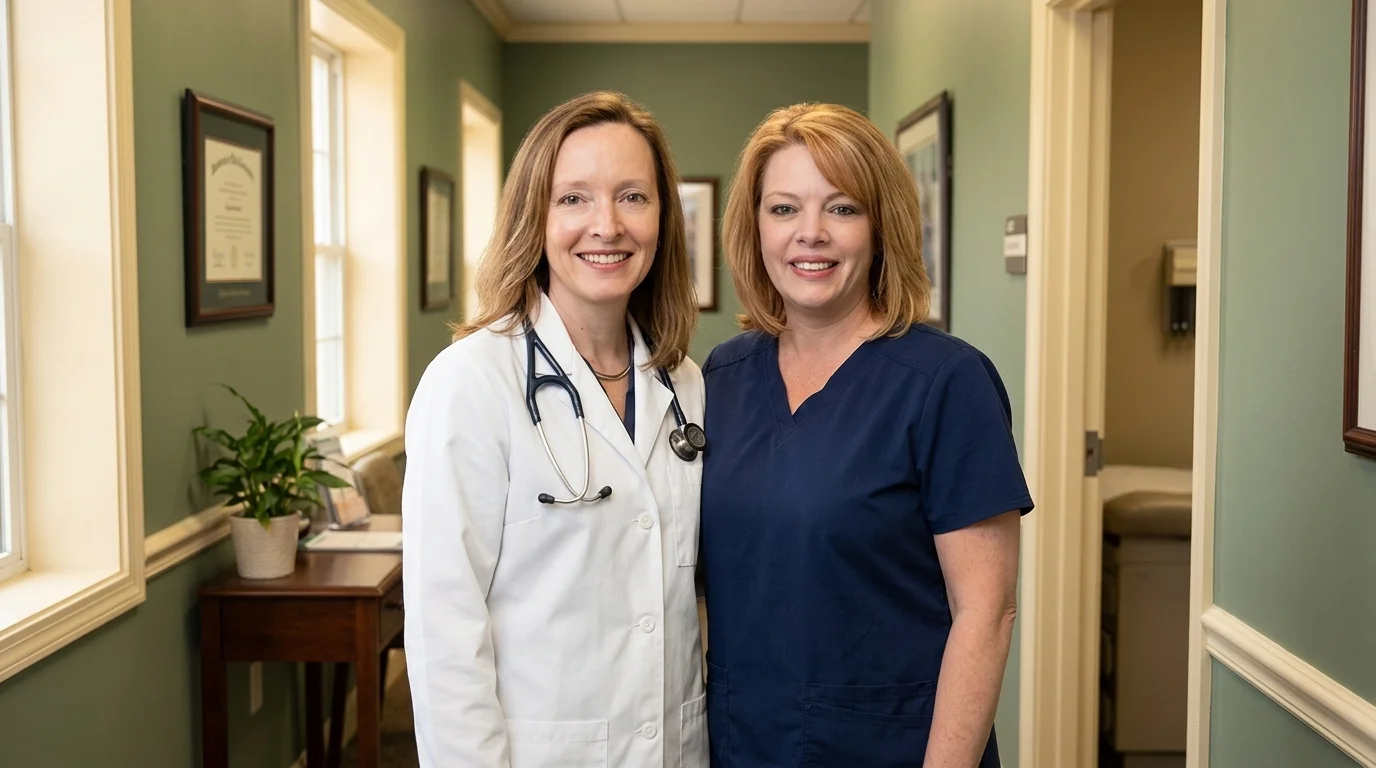
The other person you'll meet at PPHC is Jennifer Carter — and she isn't just an employee. She's Dr. Price's medical assistant of many years, her best friend, and her business partner.
"I had so much confidence in her. I wasn't worried about getting the business set up," Dr. Price said. "Day one she started already with a budget and a timeline. She knew how many patients we needed to have just to be able to pay the bills."
"I had full confidence in her. All I had to do was be the doctor — and oh my gosh, I just love being the doctor."
For a separate look at Jennifer's role and what she actually does day to day, see Meet Jennifer: The Heart Behind Prescott Professional Healthcare.
Dr. Brian Lenzkes Joining the Practice
The podcast wasn't just an interview — it was the announcement that Dr. Brian Lenzkes, founder of the LowCarbMD Podcast and the host of Life's Best Medicine, was relocating from San Diego to join the practice. Dr. Price and Dr. Lenzkes had worked together for 11 years at the same San Diego group before she moved to Prescott in 2015.
"What's the odds of us going from San Diego, we both end up in the same place, we both end up doing Direct Primary Care?" Dr. Lenzkes said on the episode. "It's just very rarely do the stars line up like this."
The partnership pairs complementary nutritional approaches: Dr. Lenzkes leans low-carb and ketogenic; Dr. Price is primarily whole-food plant-based. "I think that's what's going to be fun about working together," Dr. Lenzkes said. "We can take care of all different people based on what their desires are. But we all agree — let's cut out the processed food, let's cut out the junk, let's watch the stress, let's get our sleep right."
The shared philosophy isn't just nutritional. The American Medical Association reports that 43.2% of U.S. physicians still experience symptoms of burnout, and a 2024 Mayo Clinic Proceedings study directly links electronic health record burden to primary-care burnout. Both Dr. Price and Dr. Lenzkes describe DPC as the structural answer they couldn't find inside the corporate system.
What's Coming to the Prescott Office
Dr. Price laid out several additions she wants to bring back or build at the Stillwater office, all of which were either common in her old practice or things she's wanted to try for years:
- Cooking classes — she's run them before and stopped because hauling supplies between locations was too cumbersome. Now that the equipment can stay at the office, they're returning.
- Group walks and hikes with patients — "Talking about life, building relationships. They're getting healthier and we're getting outside."
- A relaxation / wellness room in the third exam room — possibly massage, red-light therapy, or stretching.
- IV hydration — already set up. The Prescott climate is dry enough that older adults regularly come in dehydrated. "We have these little old ladies and little old men that pass out all the time because you just don't realize how much moisture you're losing."
- Imaging and labs at wholesale prices — "You don't have to wait for insurance to clear physical therapy first. I can get you an MRI today."
The Philosophy: Address the Cause, Not Just the Symptom
One of the threads running through the conversation was both physicians' frustration with the "drug-for-every-problem" approach.
"It's a two-sided problem," Dr. Price said. "Patients come in and they want a drug. The doctor feels like if they don't give a drug, they're not doing anything."
The story she told to illustrate it: a patient who came to her with poorly-controlled diabetes, morbid obesity, and a long list of medications. His previous physician had told him his only options were a GLP-1 medication or gastric bypass surgery. Dr. Price ordered a fasting insulin level — a test the previous doctor had refused, calling it "useless." His result was 48 (normal is under 25). With diet and lifestyle changes, the patient lost 36 pounds, came off most of his medications, and his blood pressure and joint pain improved.
The clinical reasoning behind ordering a fasting insulin even when fasting glucose looks acceptable: insulin resistance can precede a type 2 diabetes diagnosis by 10 to 15 years (NIH StatPearls), giving you a long window to intervene with diet and lifestyle before drugs are necessary. Standard A1c and fasting glucose miss it.
"It's like turning the faucet on, the sink is clogged, and people are sitting there mopping up all the water," Dr. Price said. "Instead, just turn the water off — and then you solve your problem."
Why Prescott
Asked at the end of the episode what "life's best medicine" meant to her personally, Dr. Price didn't name a treatment, a diet, or a supplement.
"Being outside. Going on hikes, just being in nature and listening to the birds. That for me just calms me down. Prescott is known for its hiking — we have the best trails anywhere."
It was the same answer she gave for why she chose to relocate from San Diego in the first place. "I came around the turn, I saw this place — that was it. I was like, wow."
That's the practice, in her own words. If you'd like to enroll, the membership page has both pricing tiers and the enrollment link. If you'd like to talk to us first, our contact page has the office number and hours.
Listen to the Full Conversation
The full episode runs about 35 minutes. It's the most thorough explanation of the practice's philosophy currently anywhere on the internet, in the words of the physician who built it.
Frequently Asked Questions
Why did Dr. Price leave her previous practice?
Dr. Price left her corporate-owned practice in early 2024 because the Medicare-driven model had stopped working for patients. Wellness visits had become checklist exercises where physicians weren't supposed to address actual medical concerns, wait times for physicals had stretched to six-to-nine months, and visits were too rushed to address multiple issues. She describes the corporate medical system as 'imploding.'
What is Direct Primary Care, in Dr. Price's own words?
Dr. Price describes DPC as a return to the roots of medicine: knowing patients deeply, having time during each visit, and being available when concerns arise. Patients pay a flat monthly membership instead of fees-per-visit, the practice doesn't bill insurance, and the panel is small enough that same-day or next-day appointments are normal — not exceptions.
How long are appointments at PPHC compared to traditional primary care?
In her previous practice, Dr. Price had 12-15 minutes per patient. At PPHC, visits are unhurried — typically 30-60 minutes. Same-day or next-day appointments are standard for new health concerns, and she takes calls and texts directly from members.
Who is Jennifer Carter and what's her role?
Jennifer Carter is the Director of Operations and a nurse at PPHC. She's been Dr. Price's medical assistant for years, is her best friend, and is a business partner in the practice — not just an employee. Dr. Price credits Jennifer with handling the entire business side of the practice so that Dr. Price can focus exclusively on patient care.
Is Dr. Brian Lenzkes practicing at PPHC?
Yes. Dr. Lenzkes — host of the Life's Best Medicine podcast and founder of the LowCarbMD Podcast — relocated from San Diego to share office space with Dr. Price at the Stillwater location. Patients can choose between a primarily plant-based nutritional approach (Dr. Price) or a low-carb / ketogenic approach (Dr. Lenzkes), but both physicians cover for each other and share core philosophies on lifestyle, sleep, and minimizing unnecessary medications.
What new services is PPHC adding to the office?
Dr. Price has plans to bring back cooking classes (which she ran in San Diego), start group hikes with patients in the Prescott trails, set up a relaxation room with options like massage or red-light therapy, and continue offering IV hydration in the recliner chair already on-site. Imaging, labs, and basic wound care are already available at wholesale or cash-pay prices.
Are the prices Dr. Price quoted in the podcast still current?
The pricing she mentioned in the May 2024 episode ($100/month under 65, $125/month 65+) has been revised slightly. Current rates are $110/month for adults 19-64 and $135/month for adults 65+. Both tiers cover unlimited office visits, telemedicine, direct physician access, and same-day lab result communication. See the membership page for the most up-to-date details.