
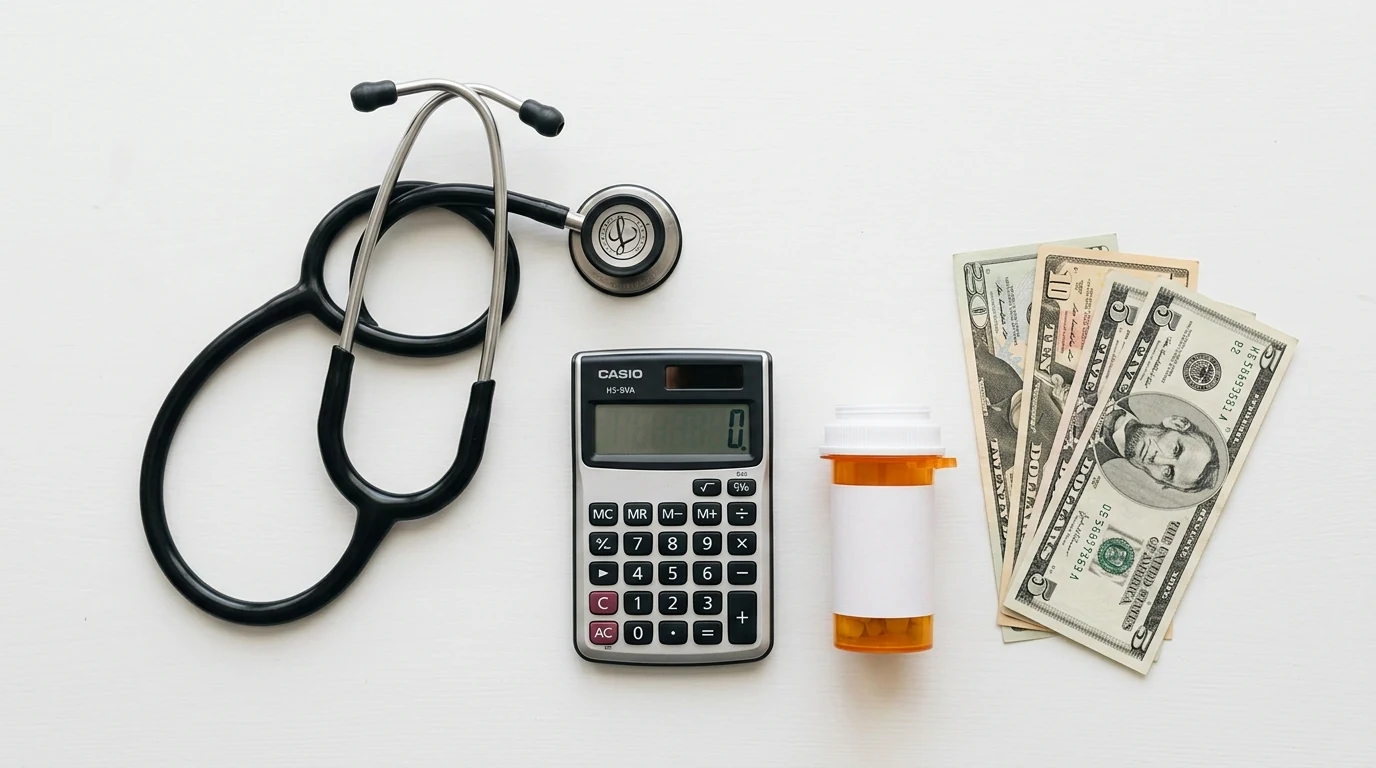
100 million Americans carry medical debt. A basic blood panel costs $200-400 through insurance billing — or under $20 at wholesale through DPC. Here's the real math behind healthcare costs and a transparent alternative.
Here's a question that shouldn't be this hard to answer: how much does it cost to see a doctor?
In almost every other industry, you know the price before you buy. A haircut. A car repair. A meal at a restaurant. But healthcare operates in a pricing fog where the same blood test can cost $2 or $200 depending on who's billing it and how.

The consequences of this opacity aren't abstract. KFF Health News found that 100 million Americans — 41% of adults — carry some form of healthcare debt, with at least $220 billion owed nationally. And 66% of Americans (KFF, 2026) say they worry about affording healthcare costs — more than food, utilities, housing, or transportation.
Let's pull back the curtain on what healthcare actually costs, what you're really paying for, and how Direct Primary Care offers a radically different approach to the math.
Key Takeaways
- 100 million Americans carry medical debt — $220 billion total (KFF)
- A basic blood panel costs $200-400 through insurance billing vs. under $20 wholesale through DPC
- DPC patients had 40.5% fewer ER visits (Society of Actuaries, 2020)
- Only 21% of hospitals fully comply with federal price transparency rules
What Does a Doctor Visit Actually Cost?
A primary care visit without insurance typically costs $150-$300, with an average of approximately $171 across major U.S. cities. That's just the visit itself — labs, imaging, and prescriptions are billed separately at $29-$99 per test.
Here's the part that makes the system feel rigged: uninsured patients often pay 2-5x more than insured patients for the identical service. Insurance companies negotiate discounted rates. If you don't have that negotiating power, you get the "chargemaster" price — a number that bears little relationship to the actual cost of providing the service.

And if you end up in the ER? The average emergency room visit costs approximately $2,600-$2,715 without insurance, with 25% of visits exceeding $3,043. Even visits that turn out to be non-emergencies average around $2,100.
In my years practicing traditional medicine, I watched patients delay care because they were afraid of the bill. Not afraid of the diagnosis — afraid of the cost. A patient with chest pain who drives home instead of going to the ER because they can't afford a $3,000 bill they might get. That's not a healthcare system. That's a system that punishes people for being sick.
Why Does a Blood Test Cost $200 Through Insurance but $2 at Wholesale?
This is the statistic that makes people's jaws drop. A complete blood count (CBC) — one of the most basic and commonly ordered lab tests — costs approximately $200-$400 when billed through the traditional insurance system. The same test, ordered at wholesale through a DPC practice, costs approximately $2.
A comprehensive metabolic panel? $300-$400 insurance-billed. About $2 wholesale. A lipid panel? $200+ insurance-billed. About $3 wholesale. A thyroid panel? $7 wholesale.
How is this possible? Because the insurance-billed price includes layers of markup, administrative overhead, billing staff salaries, insurance company negotiations, and profit margins at every step. The wholesale price is what the laboratory actually charges to run the test. When a DPC practice orders directly from Quest or Labcorp at contracted wholesale rates, you pay what the test actually costs — not what the billing system inflates it to.
The price transparency problem goes deeper than most people realize. Only 21.1% of hospitals are in full compliance with federal price transparency rules as of 2025, according to Trilliant Health — and compliance has actually declined since 2023. Across six common inpatient procedures, negotiated rates varied by an average ratio of 9.1x nationally. The same procedure, at hospitals in the same city, can cost 9 times more at one facility than another. This isn't a market — it's a maze.
Are You Overpaying for Prescriptions?
A study from the USC Schaeffer Center for Health Policy, published in JAMA, analyzed 9.5 million pharmacy claims and found that in 23% of prescription transactions, the copay patients paid exceeded the actual cost of the drug. For generic medications, overpayments occurred 28% of the time, averaging $7.69 per prescription.
Read that again: nearly one in four times you fill a prescription, you're paying more with insurance than you would paying cash. For generics — the drugs that are supposed to be the affordable option — it happens even more often.
DPC doesn't include prescription drug coverage, but we help patients find the most affordable option for every medication. Sometimes that means using your insurance. Sometimes it means using GoodRx, Mark Cuban's Cost Plus Drugs, or direct pharmacy cash prices. The right answer changes by medication — and having a doctor with the time to help you figure it out saves real money.
The $5.3 Trillion Question: Where Does the Money Go?
U.S. healthcare spending reached $5.3 trillion in 2024 — $15,474 per person — growing 7.2% and representing 18% of GDP, according to CMS (2025). We spend more per capita on healthcare than any country in the world.
And yet, Commonwealth Fund research (2024) found that U.S. seniors skip or delay needed care at the highest rate among 10 surveyed wealthy nations. Nearly 25% of U.S. adults 65+ spent at least $2,000 in out-of-pocket costs in the past year. Twenty percent skipped needed dental care due to cost.
Where does the money go? Not to primary care. The Milbank Memorial Fund's 2025 Primary Care Scorecard found that primary care accounts for under 5% of total U.S. healthcare spending — and only 3.4% of Medicare spending. The care that prevents expensive downstream problems receives the smallest slice of the budget.
How Does DPC Change the Cost Equation?
Direct Primary Care removes the billing infrastructure that inflates costs. No insurance billing department. No coding staff. No prior authorization nurses. No collections agency. That overhead — which consumes an estimated 30-40% of traditional practice revenue — disappears.
The result is straightforward pricing. At Prescott Professional Healthcare: $110/month for adults 19-64. $135/month for adults 65+. That covers unlimited visits, same-day appointments, telemedicine, direct physician access, and same-day lab result communication. No copays. No surprise bills. No per-visit charges.
The downstream effects are measurable. The Society of Actuaries/Milliman study (2020) found that DPC patients had 40.5% fewer emergency department visits, a 19.9% lower hospital admission rate, and 12.6% lower overall healthcare demand compared to traditional PPO patients.
That 40.5% ER reduction is the key number. When you can call or text your doctor about a concerning symptom and get a same-day appointment, you don't drive to the ER for a $2,700 visit that turns out to be something manageable. Better access to primary care directly reduces the most expensive category of healthcare spending.
The Math for a Prescott Retiree
Let's make this concrete. Here's what a typical year might look like for a retiree managing hypertension and pre-diabetes:
Traditional care (with Medicare):
- 4 office visits × $40 copay = $160
- 2 blood panels × $150 after deductible = $300
- 1 ER visit for chest pain scare = $500+ after Medicare
- Specialist referral copay = $65
- Unpredictable prescription costs throughout the year
- Total: $1,000+ in unpredictable out-of-pocket costs
DPC + Medicare:
- DPC membership = $135/month ($1,620/year) — unlimited visits, no copays
- 2 blood panels at wholesale = $10 total
- No ER visit (called Dr. Price, got same-day appointment instead)
- Specialist referral through Medicare (same copay)
- Total: $1,630 in completely predictable costs — and more care received
The DPC total is slightly higher in raw dollars. But you received unlimited visits instead of 4. You got same-day access instead of waiting weeks. You avoided a $500+ ER bill. And you never once had to wonder what something was going to cost.
In my practice, the patients who save the most money with DPC aren't the ones who rarely see a doctor. It's the ones who see me frequently — the ones managing chronic conditions who need regular check-ins, medication adjustments, and lab monitoring. In traditional care, those frequent visits add up in copays and deductibles. In DPC, they're included. The more you need your doctor, the more value the membership delivers.
Transparent Pricing Is a Choice
The healthcare pricing system is opaque by design. It benefits insurers and large hospital systems. It does not benefit you.
DPC is a deliberate choice to step outside that system for your primary care — the care you use most often, the care that prevents the expensive downstream problems, the care that should be the easiest to access and the simplest to understand.
At Prescott Professional Healthcare, you'll never get a surprise bill. You'll never wonder what a visit costs. And you'll never delay calling your doctor because you're worried about what it'll cost to ask a question.
Become a member or call us at 928-515-2803. We'll tell you exactly what it costs — because we believe you deserve to know.
Frequently Asked Questions
How much does a doctor visit cost without insurance?
A primary care visit without insurance typically costs $150-$300, with an average of $171 across major U.S. cities. Labs are billed separately at $29-$99 per test. Uninsured patients often pay 2-5x more than insured patients for the same service. DPC membership ($110-$135/month) covers unlimited visits with no per-visit charges.
How much does an ER visit cost without insurance?
The average ER visit costs approximately $2,600-$2,715 without insurance, with 25% of visits exceeding $3,043 (claims analysis data, 2025). Even non-emergency ER visits average around $2,100. DPC reduces ER usage by 40.5% by providing same-day access to your physician for non-emergency concerns.
Why are lab tests so much cheaper through DPC?
DPC practices bypass the insurance billing system and order labs at wholesale prices directly from laboratories like Quest and Labcorp. A CBC that costs $200+ through insurance billing costs approximately $2 at wholesale. A comprehensive metabolic panel that costs $300-$400 billed through insurance costs approximately $2 wholesale.
How many Americans have medical debt?
100 million Americans (41% of adults) carry some form of healthcare debt, with at least $220 billion owed nationally (KFF, 2022). 14 million adults owe over $1,000 and 3 million owe over $10,000. Medical debt is the leading cause of personal bankruptcy in the United States.
Is DPC cheaper than traditional healthcare with insurance?
DPC membership costs $110-$135/month for primary care. The Society of Actuaries found DPC patients had 40.5% fewer ER visits and 12.6% lower overall healthcare demand. While DPC doesn't replace insurance for hospitalizations and specialists, the predictable monthly cost eliminates copays, surprise bills, and the unpredictable expenses that drive medical debt.