
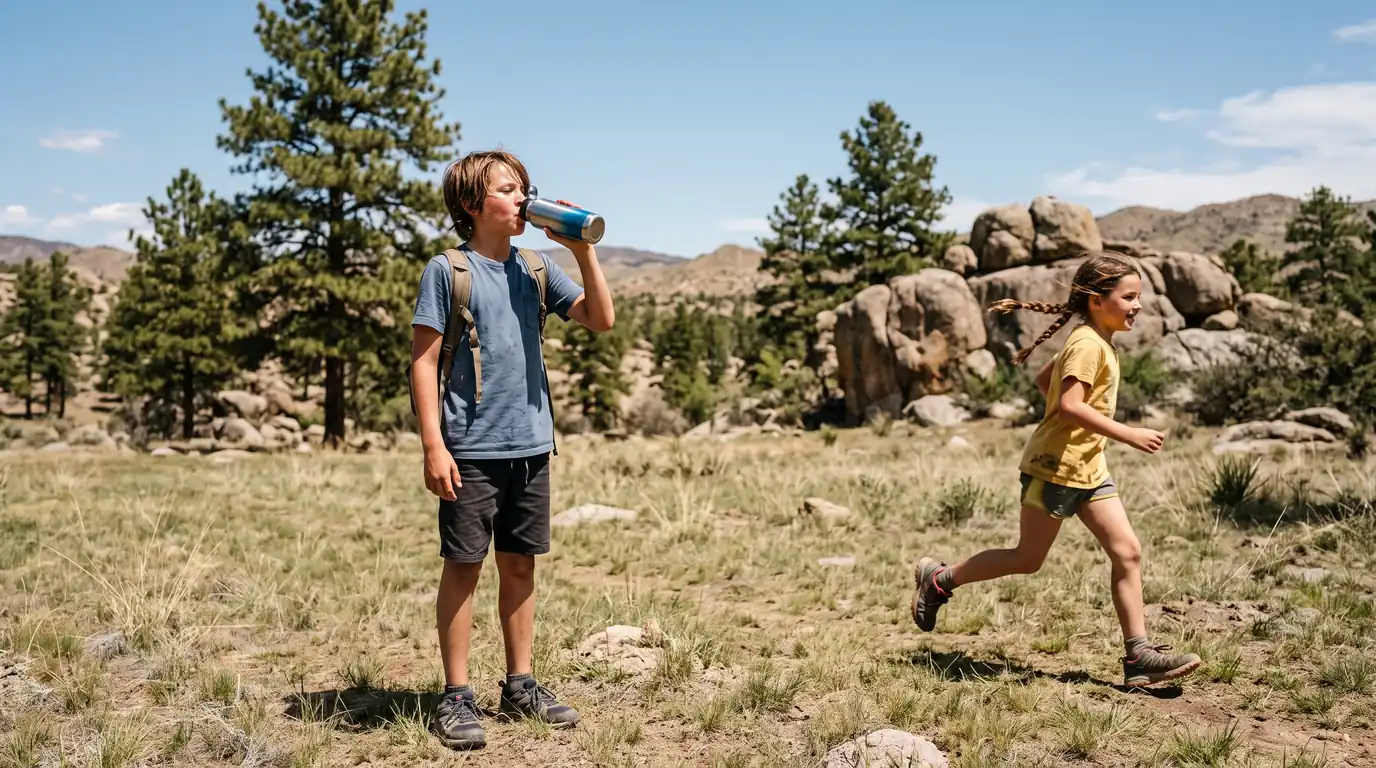
The idea that kids can't cool themselves like adults is outdated, and believing it makes parents watch the wrong thing. Here's what Arizona's ER data shows, and the four signs most often misread.
Most of what Prescott parents were taught about children and heat has been quietly retired by the people who taught it. The American Academy of Pediatrics reversed its position on pediatric heat tolerance, then reaffirmed that reversal in March 2025. A systematic review published this February confirmed it again across 22 separate studies.
This is not a small correction. If you believe a child's cooling system is inherently weaker than yours, you watch a thermometer and a water bottle. If you understand that the system is intact but conditional, you watch something else entirely: behavior. Behavior is where the real warning shows up, and in my experience it is the last thing anyone checks.
Prescott averages 46 days a year at or above 90F and only two at or above 100F, according to Arizona State Climate Office normals. We are not Phoenix. That is exactly why heat illness catches families here off guard, and why Yavapai County children still land in emergency departments every summer.
Key Takeaways
- Hydrated children control core temperature as well as adults. Across 22 studies, no difference in core temperature change was found (Falk et al., Temperature, 2026).
- Arizona ED visits for heat illness in children 1-14 rose from 54 in 2020 to 185 in 2024, and teens 15-19 outnumber them at 246.
- More than 50% of children in heat stroke are not sweating, so "still sweating" is not reassurance.
- Confusion, irritability and dropping performance appear on Arizona's official heat illness sign list. Those are neurologic findings, not attitude.
- September is not the off-season: 529 statewide ED visits in September 2024 versus 254 in May.
Can children really not cool themselves as well as adults?
No, and the correction is official. The AAP policy statement on climatic heat stress states that "contrary to previous thinking, youth do not have less effective thermoregulatory ability" compared with adults during exercise in the heat when adequate hydration is maintained (Pediatrics, reaffirmed March 2025).
A February 2026 systematic review in the journal Temperature pooled 22 studies comparing children and adults under heat stress. In not one of them was the change in core temperature different between the two groups. Not one. The finding held across protocols, humidity levels and age bands.
Children do sweat less. Sixteen of 19 studies found sweat rates 13% to 74% lower per unit of skin area. But 7 of 10 studies found skin blood flow 16% to 83% higher. Kids push heat to the surface and shed it by radiation and convection instead of evaporating it. Different strategy, identical result.
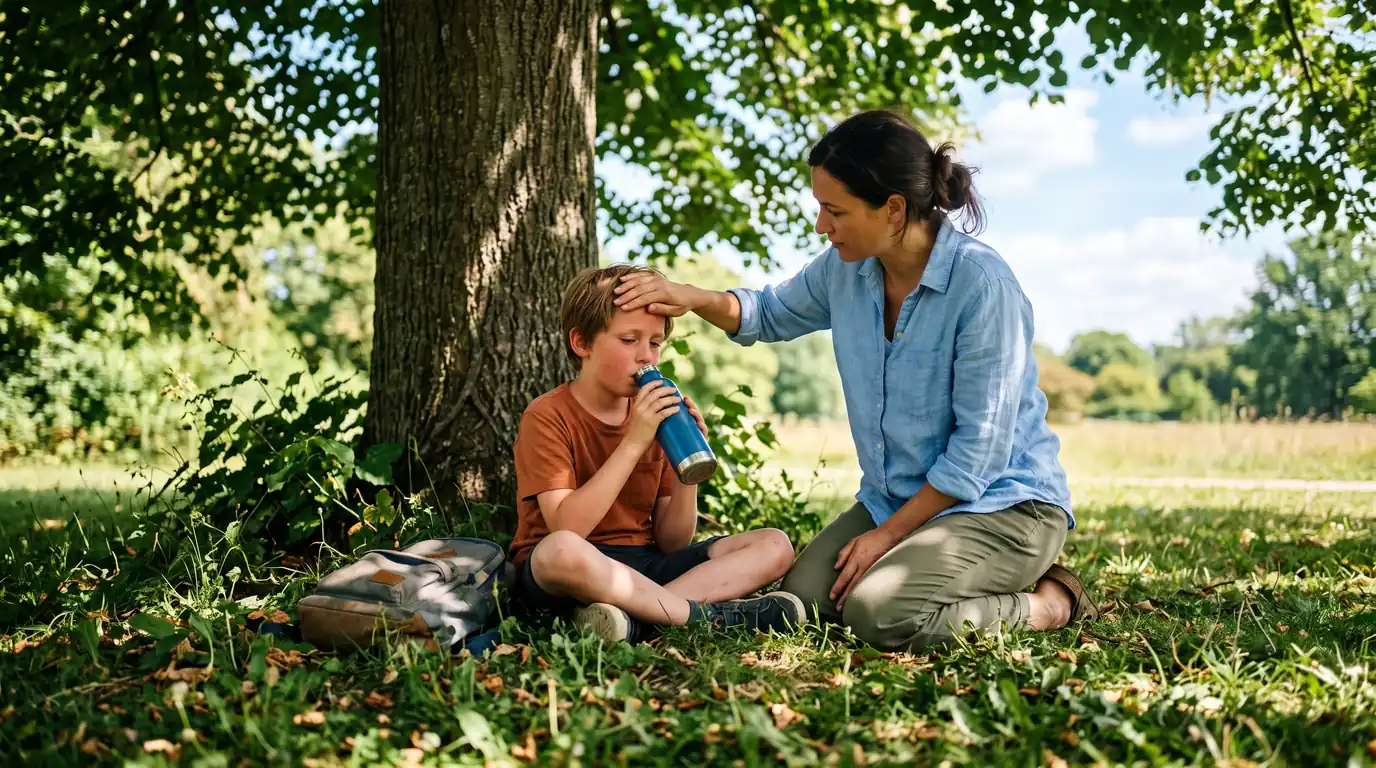
The whole finding rests on one clause: when adequate hydration is maintained. Remove the water and the compensation collapses. So pediatric heat risk is real. It just isn't a broken thermostat. It's behavioral and situational.
Three things make children vulnerable, and none of them is physiology. They won't stop playing. They under-drink even with a full bottle sitting beside them. And they can't get themselves out of a car. The vital sign here is behavior, not physiology.
Arizona's heat data points at a teenager, not a toddler
Arizona Department of Health Services counted 185 heat-related illness emergency department visits among children ages 1 to 14 in 2024, up from 54 in 2020. Adolescents ages 15 to 19 accounted for 246 visits, more than the entire younger group combined (Arizona DHS, 2020-2024).
| Arizona heat-related illness ED visits | 2020 | 2021 | 2022 | 2023 | 2024 |
|---|---|---|---|---|---|
| Children, ages 1-14 | 54 | 114 | 134 | 144 | 185 |
| Adolescents, ages 15-19 | 123 | 147 | 155 | 200 | 246 |
Infants under 1 went from 7 visits in 2020 to 25 in 2024. Small absolute numbers, steep direction. The 1-14 group more than tripled over five years.
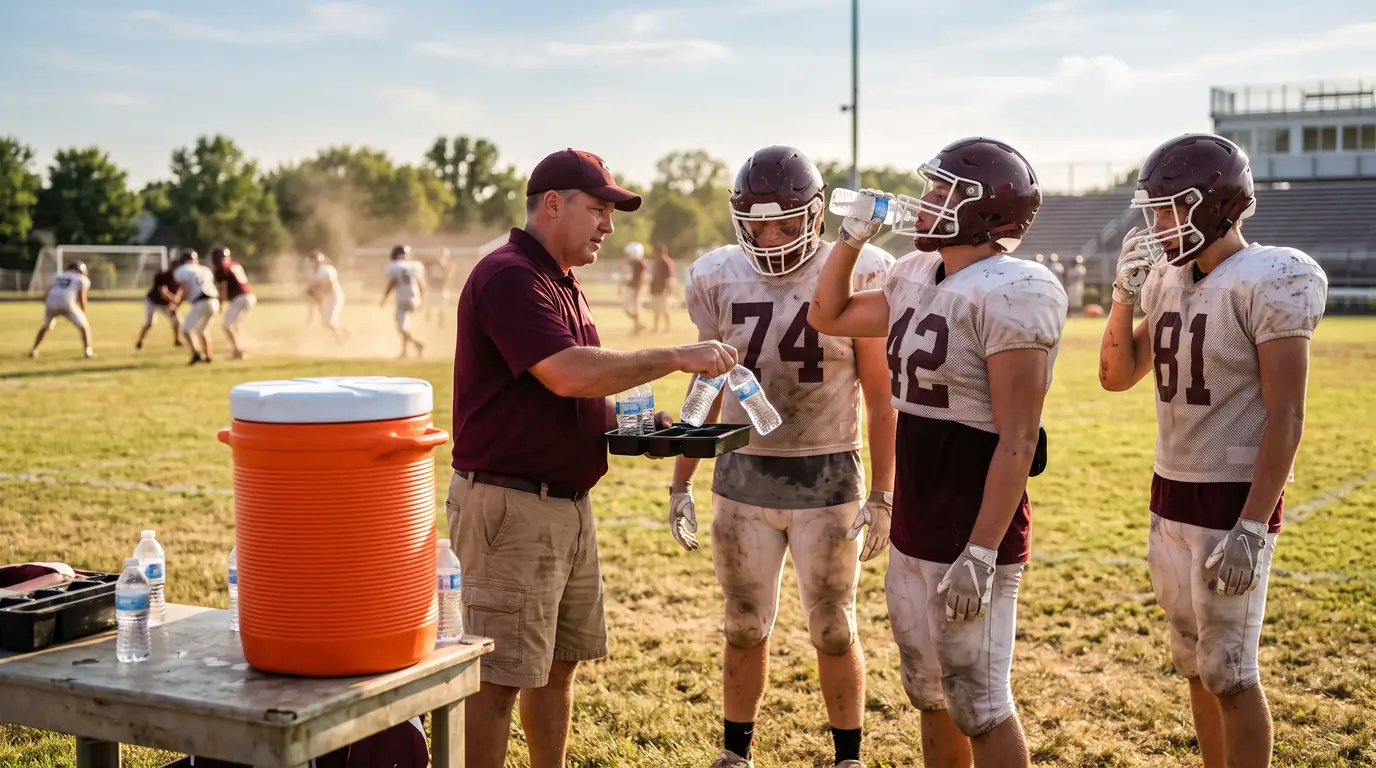
The shape of that data should change the picture in your head. The typical Arizona pediatric heat patient is not a toddler at a splash pad. She is disproportionately a high schooler in a uniform, at practice, in August, doing exactly what an adult told her to do.
Locally, Yavapai County residents made 70 heat-related ED visits in 2024, up from 39 in 2020. Our 2024 rate of 27.8 per 100,000 sits between Coconino County's 15.3 and Maricopa County's 64.1. Prescott is not immune. We're simply in the middle of the state's range, which is a harder place to stay vigilant.
And September is not the off-season. Statewide, September 2024 produced 529 heat-related ED visits against 254 in May. Prescott's mean September high is 83.3F, with four more days at or above 90F still on the calendar. Fall sports begin while the heat is very much here.
The four warning signs Prescott parents misread
Heat illness in clinic is rarely missed because a parent wasn't paying attention. It's missed because the child contradicted a rule of thumb. Four misreads account for most of what I see, and each is directly refuted by published guidance. Start with the fact that more than 50% of children in heat stroke do not sweat.
1. "He's still sweating, so he's fine"
This one is backwards. AAP guidance describes heat stroke as hot, flushed skin with fever higher than 105F plus confusion, coma or shock, and notes that more than 50% of children with heat stroke do not sweat. Profuse sweating with pale skin belongs to heat exhaustion, the less dangerous condition. Sweat is not a safety signal. Its absence in a hot, struggling child is an alarm.
2. "She's just being crabby"
Arizona's own athletic rulebook lists "confusion or just look 'out of it'," "irrational behavior, irritability, emotional instability" and "decreasing performance or weakness" among the signs of heat illness (AIA Article 43). Those are neurologic findings. A normally easygoing kid who turns snappish and sloppy in hour three of a hot practice is showing you a brain that is too warm.
3. "Let him rest a minute"
High school football carries an exertional heat illness rate of 4.42 per 100,000 athlete-exposures, 11.4 times the rate of all other sports combined, Across all high school sports, 60.3% of exertional heat illness cases occur in August, and in 33.6% of cases no medical professional was on site (Kerr et al., American Journal of Preventive Medicine, 2013). A third of the time, the person judging whether resting is enough has no clinical training. Resting in the same heat is not cooling.
4. "He drinks when he's thirsty"
Thirst lies, and it lies early. After just 10 minutes of drinking freely, subjects' thirst had returned to normal while they were still 2.1% dehydrated (Adams et al., Nutrients, 2019). That's in adults paying attention. In a child chasing a ball, the gap is wider. Put drinking on a clock instead of waiting to be asked.
How hot does a parked car get on a 75-degree Prescott day?
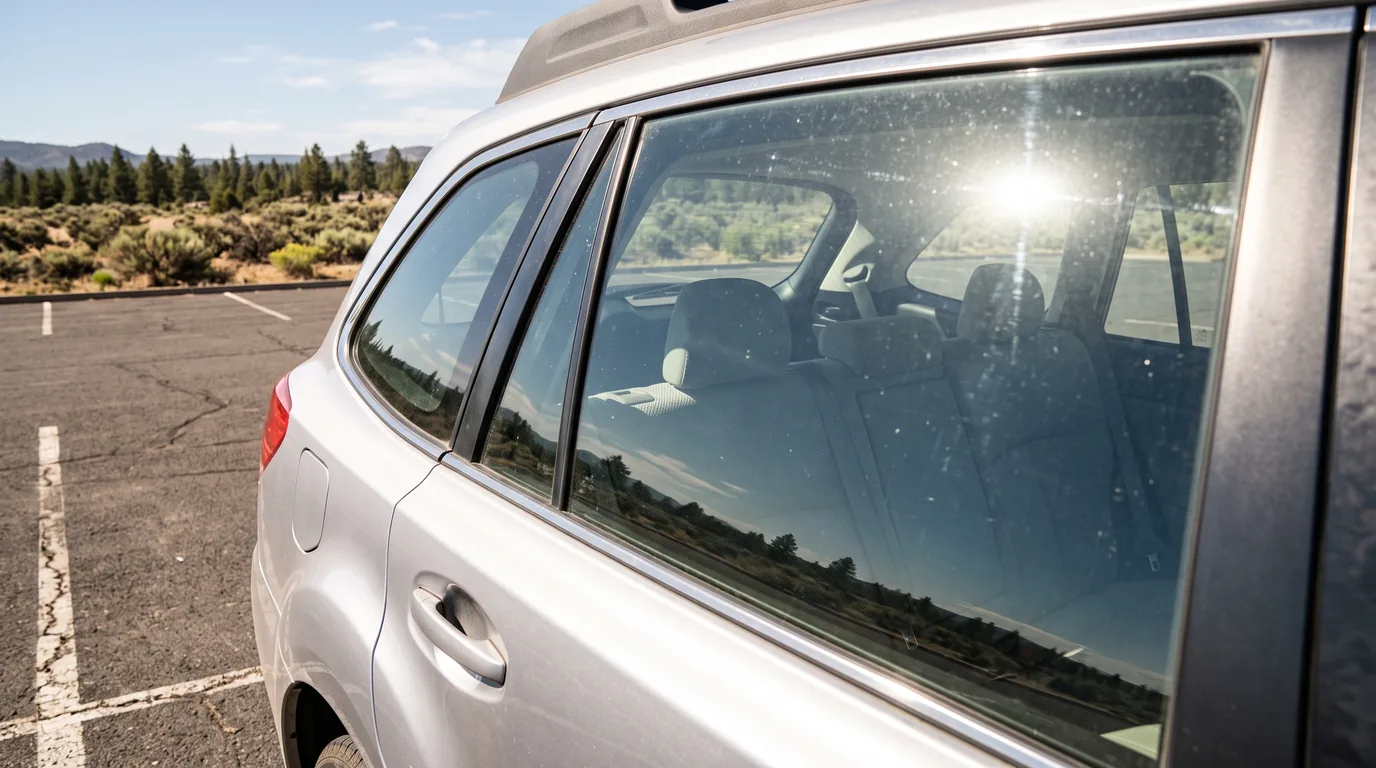
Dangerously hot, and faster than almost anyone believes. In a study published in Pediatrics testing ambient temperatures of 72F to 96F, which is Prescott's exact warm-season range, the average interior increase was 3.2F every five minutes, with 80% of the total rise occurring in the first 30 minutes (McLaren, Null and Quinn, 2005).
Two details from that study deserve to be repeated to every parent in this county. Even at the coolest ambient temperature tested, vehicle interiors reached 117F. And cracking the windows 1.5 inches produced final temperatures that were identical to leaving them shut. The window trick does nothing.
Since 1998, 1,068 American children have died of vehicular heatstroke, averaging 37 per year, according to NoHeatstroke.org data compiled at San Jose State University and updated August 2026. Of those deaths, 52.9% involved a child forgotten by a caregiver, 23.8% a child who gained access to a vehicle on their own, and 21.9% a child knowingly left behind. Fifty-four percent were under age 2.
Look closely at that breakdown, because two of the three categories aren't forgetting. Nearly a quarter of these children climbed into a car by themselves, which makes locking your vehicle in your own driveway a pediatric safety measure. Another fifth were left on purpose by someone who thought five minutes was nothing. Five minutes is 3.2F.
What are Arizona's actual rules for practicing in the heat?
Arizona has binding, numeric limits, and most parents have never seen them. The Arizona Interscholastic Association's Article 43 sets practice restrictions by wet bulb globe temperature, or WBGT, a measurement that accounts for humidity, radiant heat and wind. At 92F WBGT and above, outdoor workouts are prohibited outright.
| WBGT reading | Required practice modification (AIA Article 43, 2026-27) |
|---|---|
| Under 82.0F | Normal activity. Minimum three-minute break every 20 minutes. |
| 82.1F to 86.9F | Use discretion for intense or prolonged exercise. Minimum four-minute break every 20 minutes. |
| 87.0F to 90.0F | Maximum two hours of practice. Minimum four-minute break every 15 minutes. Football limited to helmets, shoulder pads and shorts. |
| 90.1F to 91.9F | Maximum one hour of practice. Minimum five-minute break every 15 minutes. No conditioning activities. No protective equipment. |
| 92.0F and above | No outdoor workouts. |
WBGT is not the number on your weather app. It has to be measured on site, on the surface the kids are actually standing on. Two fair questions for any Prescott athletic director: do you measure WBGT at the field, and do you have cold water immersion available?
The AIA is also blunt about thermometers, and this is the single most useful sentence in the document:
"Temporal, aural, oral, skin, axillary and tympanic temperature are not valid and should never be utilized in diagnosis of a potential exertional heat stroke. Rectal temperature is the only valid measuring tool sensitive enough to accurately diagnose exertional heat stroke."
That is the state association's language, not mine, and it should change what happens on a sideline. A forehead scanner reading 100F on a collapsing athlete is not reassurance. It is noise. The protocol is also explicit about sequence: Cool First, Transport Second. The instinct is to load the child into a car and drive. The guidance is to cool on site first.
Why does Prescott's dry mountain air hide the problem?
Dry air makes heat stress harder to see, not easier to survive. The National Weather Service notes that heat index values assume shady conditions, and that full sunshine can raise heat index values by up to 15F. On an exposed trail at noon, the 88F on your phone is not what your child is experiencing.
Elevation adds a second layer. UV intensity increases roughly 2% per 1,000 feet, so Prescott at about 5,400 feet gets around 11% more UV than sea level, according to the EPA. UV is invisible and produces no sensation of heat, so there is no felt warning before a burn. Sunburned skin sheds heat less efficiently, so a rough Saturday makes Sunday worse.
Now stack the chain. Children sweat less per unit of skin than adults. In single-digit humidity that sweat evaporates before anyone sees a soaked shirt. Thirst switches off while a real deficit remains. And the sun is adding heat the forecast number never accounted for. Every link points the same way: the visual cues you instinctively rely on are muted here.
I've written about the same physics for adults in summer hiking safety for Prescott trail users. The mountain does not adjust its rules for a nine-year-old, and a child on Thumb Butte in July is doing an adult workout in an adult environment.
When do you call 911, and when is it the emergency room?
There are two thresholds, and they are deliberately different numbers. AAP guidance defines heat stroke as hot, flushed skin with a fever higher than 105F plus confusion, coma or shock. But it tells parents to go to the emergency department at 104F. Think of 104F as the act-now line and 105F as the diagnostic line.
Call 911 now if a child is hard to arouse, acts or talks confused, has a seizure, shows signs of shock, or has a fever above 105F. Go to the ER now if the child lost consciousness, cannot stand, or has a fever above 104F.
Notice what dominates those lists. Four of the five 911 criteria are neurologic or circulatory. Only one is a number on a thermometer. If your child is confused at 101F, the 101 is irrelevant. Treat the confusion.
That's also why I don't want families anchoring on a home thermometer during a heat event. As the AIA states plainly, the readings most parents can obtain cannot rule out exertional heat stroke. If the behavior is wrong, act on the behavior and start cooling while you call.
What I tell Prescott families before the season starts
My advice is short, because the data supports only a handful of high-yield moves. With 60.3% of high school exertional heat illness cases falling in August and 52.9% of vehicular heatstroke deaths involving a forgotten child, most of the prevention here is calendar and routine, not equipment.
- Ease into the first weeks of practice instead of starting at full intensity in full pads.
- Put fluids on a clock. Thirst is a lagging indicator, not a prompt.
- Ask the school two questions: is WBGT measured on site, and is cold water immersion available?
- Lock the car in your own driveway, every time. Almost a quarter of these deaths are children who let themselves in.
- Treat September like August. Arizona's September ED visits doubled May's in 2024.
- Watch personality, not the thermometer. Irritable, confused or sloppy is a medical finding.
If your child has had a heat episode, plays a fall sport, or takes a medication that affects sweating or hydration, that's worth a conversation before the season rather than after. In a direct primary care practice I have the time to review medications, history and a written plan in a single unhurried visit. You can reach my office through the contact page.
None of this warrants panic, and the numbers don't support panic. Arizona's pediatric counts are climbing from small bases, and the interventions are unglamorous and effective. Watch behavior. Schedule the water. Lock the car. That covers most of it.
Frequently Asked Questions
Do children overheat faster than adults?
Not when they're hydrated. A 2026 systematic review of 22 studies found the change in core temperature during heat stress was no different between children and adults in any study. Kids sweat 13-74% less but offset it with 16-83% higher skin blood flow. The risk is behavioral, not physiological.
What is the first sign of heat exhaustion in a child?
Usually pale skin with profuse sweating, nausea and fatigue, with temperature reaching 100-102F briefly or staying normal, per AAP guidance. Heat stroke looks different: hot flushed skin, confusion, and fever above 105F. More than 50% of children in heat stroke are not sweating at all.
At what temperature should I take my child to the ER for heat illness?
AAP guidance directs parents to the emergency department at a fever above 104F, or for loss of consciousness or inability to stand. Call 911 at above 105F, or for confusion, seizure, difficulty arousing, or shock signs. 104F is the act-now line; 105F is the diagnostic line.
Is it safe to leave a child in a car with the windows cracked in Prescott?
No. In Pediatrics research conducted at 72-96F ambient, interiors rose 3.2F every five minutes and cracking windows 1.5 inches produced identical final temperatures. Even at the coolest temperature tested, interiors reached 117F. Nationally, 1,068 children have died of vehicular heatstroke since 1998.
Does Prescott's elevation protect kids from heat illness?
Only partly. Prescott averages 46 days at or above 90F, far fewer than Phoenix, but Yavapai County residents still made 70 heat-related ED visits in 2024. Our rate of 27.8 per 100,000 sits well above Coconino County's 15.3. Elevation also adds about 11% more UV exposure.
When must an Arizona school stop outdoor practice for heat?
AIA Article 43 prohibits outdoor workouts at a wet bulb globe temperature of 92F or above. Between 90.1F and 91.9F, practice is capped at one hour with no conditioning and no protective equipment. Between 87.0F and 90.0F, practice is capped at two hours.