

Almost 44% of Americans 65 and older take five or more prescriptions. Here is how a real medication review works, what the Beers list actually means, and why tapering always beats quitting.
I have lost count of how many times someone has set a bag of pill bottles on my desk and been able to explain maybe half of them. That is not a failure of memory or intelligence. It is what happens after fifteen years of perfectly good care from four different specialists, none of whom ever saw the whole bag at once.
Here is the number that should reframe this whole conversation. Adults 65 and older visit the emergency department for medication harms at a rate of 12.1 per 1,000 people each year, more than twice the rate of 5.0 among adults under 65, and 69.1% of those visits involve a drug taken exactly as prescribed (Budnitz et al., JAMA 2021). Not misused. Not doubled up by accident. Taken correctly.

So let me say the most important thing before anything else. Do not stop, skip, or cut in half any medication because of something you read here, including this article. Several of the drugs most often involved in serious harm are also drugs that cause serious harm when they disappear suddenly. Every change belongs in a conversation with the person who prescribed it.
Key Takeaways
- Roughly 44% of US adults 65 and older take five or more prescriptions, and Yavapai County's median age of 55.3 makes that national picture unusually relevant to Prescott.
- Four ordinary drug classes, warfarin, insulin, antiplatelets, and oral diabetes pills, caused 67.0% of emergency hospitalizations for drug harms in older adults. Drugs on the Beers "high-risk" list caused 1.2%.
- The Beers Criteria flags potentially inappropriate medications. It is not a banned-drug list, and reading it as one is the most common and most dangerous mistake.
- Deprescribing trials show medication lists can be shortened safely. They have not shown that shorter lists make people live longer, so expect specific wins rather than miracles.
- Never stop a medication on your own. Rebound and withdrawal effects are real, and they are routinely mistaken for proof that the drug was necessary.
How common is polypharmacy after 65?
More common than most people assume. Between 2017 and 2020, 43.8% of US adults aged 65 and older took five or more prescription medications, up from 39.3% in 2011-2012 (NHANES analysis, J Gerontol A 2024). Among older adults taking at least one prescription, 5.5% take ten or more (Age Ageing 2026).
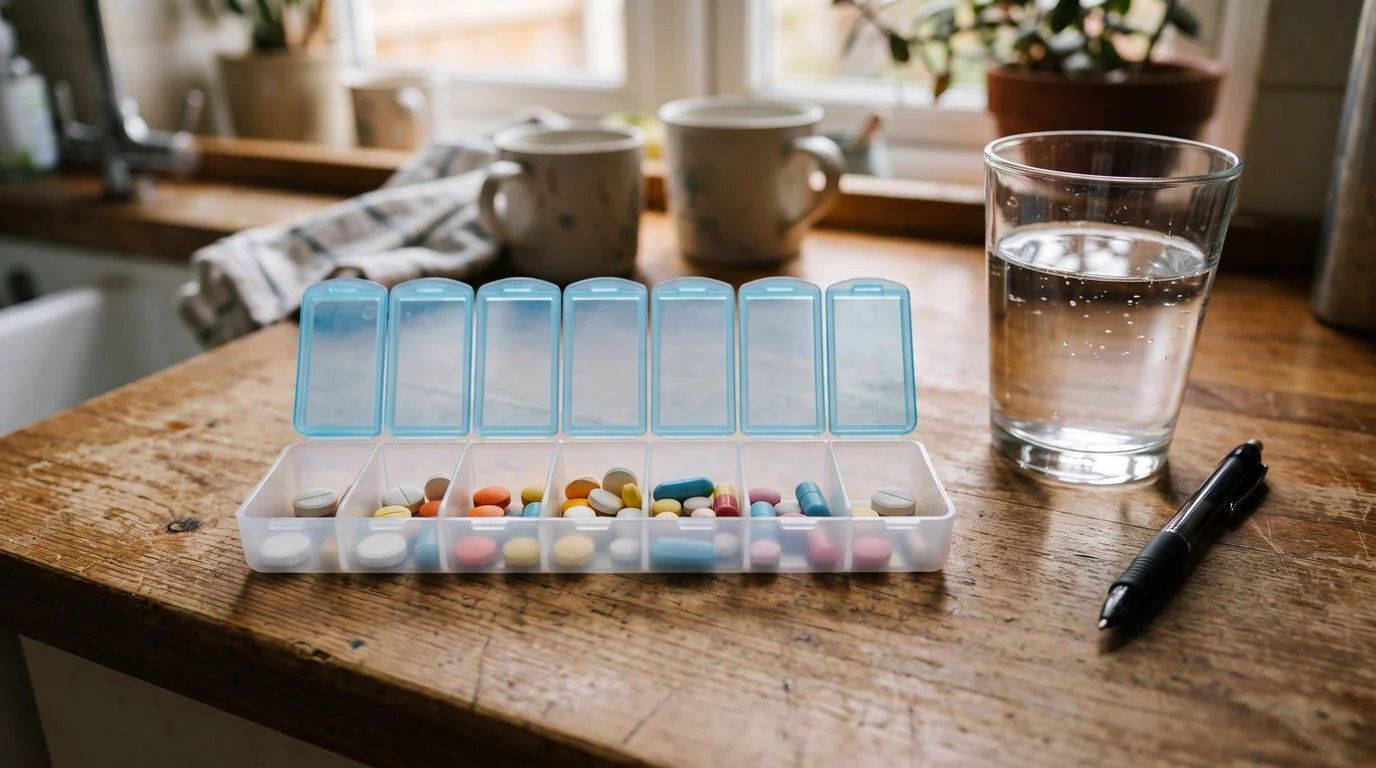
Those national numbers land differently here. Yavapai County's median age is 55.3, roughly 1.4 times both the Arizona and the US median (US Census ACS 2024). A statistic about Americans over 65 describes a far larger slice of Prescott than it does of an average American county. When I read a study about polypharmacy, I am reading about a big share of the people in my waiting room.
I want to be careful here, because "polypharmacy" gets used as an accusation. It is not one. It is a count. A person with atrial fibrillation, heart failure, diabetes, and osteoporosis may need nine medications, every one of them earning its place. The problem is not the number. It is a number nobody has reviewed as a whole in years.

Which medications actually send older adults to the hospital?
Ordinary ones. Four common drug classes accounted for 67.0% of emergency hospitalizations for adverse drug events in adults 65 and older during 2007 to 2009: warfarin at 33.3%, insulins at 13.9%, oral antiplatelet agents at 13.3%, and oral hypoglycemic agents at 10.7% (Budnitz et al., NEJM 2011).
Now look at the other half of that same study. Medications identified as "high-risk" in older adults, the ones on the famous avoid lists, accounted for only 1.2% of those hospitalizations. Two orders of magnitude apart. If you were building a safety strategy around avoiding exotic bad drugs, the data says you would be watching the wrong shelf.
This is the spine of everything I do in a medication review, so let me put it plainly. The thing most likely to hurt you is not a strange drug you never should have received. It is a necessary drug that needs a lab check, a smaller dose, or an interaction screen. Warfarin is not the villain in that 33.3%. Warfarin plus a new antibiotic plus a missed INR check is.
Insulin works the same way. The dose that was right two years ago can become too much when appetite drops, weight falls, or kidneys slow. Nothing about the prescription changed. Everything about the person did. That gap is where the emergencies live, and it is a monitoring problem, not a bad-drug problem.
The Beers Criteria is not a list of banned drugs
The current edition is the 2023 update from the American Geriatrics Society (J Am Geriatr Soc 2023;71(7):2052-2081), and the operative word in it is potentially inappropriate. It has five categories, and two of them, "use with caution" and "adjust for kidney function," are not avoidance categories at all. It also explicitly excludes hospice and end-of-life care.
I bring this up because I have watched the misreading cause harm. Someone finds the list online, recognizes three of their own medications, and stops all three over a weekend. That is precisely the unilateral stopping this article exists to prevent. Abrupt benzodiazepine withdrawal, for one example, is genuinely dangerous, and the risk of stopping badly can exceed the risk of continuing.
The classes that show up most often, and the reasons behind them:
- Benzodiazepines and Z-drugs such as zolpidem: falls, confusion, delirium.
- First-generation antihistamines such as diphenhydramine: anticholinergic effects.
- Proton pump inhibitors continued past eight weeks without a clear ongoing indication.
- NSAIDs such as ibuprofen and naproxen: GI bleeding, kidney injury, higher blood pressure.
- Muscle relaxants and anticholinergics broadly.
- Sulfonylureas, glyburide especially, because of prolonged low blood sugar.
Read that as a list of conversations to have, not a list of pills to throw away. Every one of those drugs is the right choice for somebody.
The anticholinergic question deserves an honest answer
In a cohort followed for up to a decade, the highest cumulative anticholinergic exposure, roughly three or more years of daily use, was associated with a hazard ratio of 1.54 for incident dementia (95% CI 1.21 to 1.96), with a clear dose-response pattern (Gray et al., JAMA Intern Med 2015).
A larger UK analysis of 58,769 dementia cases found a similar odds ratio of 1.49 and estimated a population-attributable fraction of 10.3% (Coupland et al., JAMA Intern Med 2019). Two large studies, two continents, similar signal.
Now the honesty part, which you will not get from most articles on this topic. Both studies are observational, and confounding by indication is a serious concern. Early dementia itself can produce urinary urgency, insomnia, and depression, which are exactly the symptoms that lead to anticholinergic prescriptions. The drug may be a marker of the disease rather than a cause. Nobody has randomized people to years of anticholinergic burden.
So I treat it as a reason to prefer alternatives, not as a reason to panic. And here is the practical part that actually changes outcomes. In my experience the largest anticholinergic exposure in older adults is not a prescription at all. It is diphenhydramine, sitting inside over-the-counter sleep aids and anything labeled "PM." People do not think of it as medication, so they do not mention it, so it never appears on any list I see. Bring those bottles.
Which medications raise your risk of falling?
Falls are the outcome I worry about most, and for good reason: 14 million adults 65 and older, 27.6% of that population, reported falling in the previous year, and 38,742 died from falls in 2021 (CDC MMWR 2023). Meta-analyses put SSRIs at the top of the medication list, with an adjusted odds ratio of 2.02 (Seppala et al., J Am Med Dir Assoc 2018).
| Medication class | Adjusted odds ratio for falls |
|---|---|
| SSRIs | 2.02 |
| Polypharmacy itself (5 or more drugs) | 1.75 |
| Opioids | 1.60 |
| Antiepileptics | 1.55 |
| Antipsychotics | 1.54 |
| Benzodiazepines | 1.42 |
| Loop diuretics | 1.36 |
| NSAIDs | 1.09 (not statistically significant) |
| Beta blockers | 0.88 (slightly protective) |
Source: EuGMS Task and Finish Group on fall-risk-increasing drugs, J Am Med Dir Assoc 2018 — Part I, Cardiovascular (loop diuretics, beta blockers), Part II, Psychotropics (SSRIs, antipsychotics, benzodiazepines), and Part III, Others (opioids, antiepileptics, NSAIDs, polypharmacy).
Two things in that table surprise nearly everyone. First, beta blockers did not increase fall risk. They came in at 0.88, slightly protective, which runs against the common assumption that any blood pressure medicine must be making you dizzy. Second, and more important: polypharmacy is an independent risk factor at 1.75. The count matters, not only the contents. Five reasonable drugs still carry a risk that no single one of them explains.
Prescott adds a seasonal layer to this, since heat changes how some of these drugs behave in the body. I covered that separately in why 90 degrees hits different after 65, so I will not repeat it here.
What is a prescribing cascade?
A prescribing cascade happens when a drug's side effect gets misread as a brand new medical condition and treated with a second drug. Rochon and Gurwitz named the pattern in the BMJ in 1997. Most patients have never heard the term, and once they hear it, they start spotting it in their own bottles.
The classic example is a calcium channel blocker such as amlodipine. It commonly causes ankle swelling. Swollen ankles look like fluid overload, fluid overload gets a diuretic, and now there are two drugs where one problem existed. Among 41,086 older adults newly started on a calcium channel blocker, 1.4% began a loop diuretic within 90 days, compared with 0.7% and 0.5% in two control groups (Savage et al., JAMA Intern Med 2020).
Gabapentin and pregabalin do something similar. They cause peripheral edema, which draws a diuretic prescription at an adjusted hazard ratio of 1.44 (Read et al., JAGS 2021). Same pattern, different starting drug.
My favorite version, because it is so easy to catch, is what researchers call a cascade relic: a potassium supplement still being taken faithfully years after the diuretic that required it was discontinued (JAGS 2023). The original reason vanished. The bottle stayed. Nobody was careless. The refill just kept refilling.
If you remember one sentence from this article, make it this question: "Could this new symptom be a side effect of something I am already taking?" Ask it about every new symptom, before any new prescription.
Does deprescribing actually make people healthier?
Here is where I part company with most articles on this subject. The trials show that medication lists can be shortened safely. They have not shown that shortening them makes people live longer or feel better on average. The Shed-MEDS randomized trial cut medications by 14% with adverse drug event rates similar between groups (JAMA Intern Med 2023).
Other trials show the same thing: you can reliably change what people take. D-PRESCRIBE achieved discontinuation of a targeted inappropriate medication in 43% of patients versus 12% with usual care (JAMA 2018). The EMPOWER trial mailed older adults an education booklet, nothing more, and 27% discontinued their benzodiazepine compared with 5% of controls (JAMA Intern Med 2014). A booklet.
Then there is the counterweight nobody quotes. OPTIMIZE, the largest trial of the group at 3,012 patients, was flatly null on both medication count and inappropriate medication use (JAMA Intern Med 2022). Cochrane, reviewing the field, rates the certainty of the evidence as low to very low (Cochrane Database Syst Rev 2018).
Does that make deprescribing pointless? Not remotely. It means the real benefits are specific rather than global. Fewer falls when a sedative comes off. Fewer low blood sugar episodes when a sulfonylurea comes off. Less confusion when an anticholinergic comes off. Those are concrete wins for the person in front of me, and they are reason enough. I do not need to promise you extra years to justify the work.
Should you stop your acid reflux medication?
Not on your own, and probably not for the reasons circulating online. The COMPASS trial randomized 17,598 people to pantoprazole or placebo for a median of three years and found no significant difference in any safety outcome except enteric infections, at 1.4% versus 1.0% (Gastroenterology 2019). The internet has badly overstated the danger.
But stopping abruptly does backfire, and this is the part almost nobody knows. Researchers gave healthy volunteers with no reflux at all a PPI for eight weeks, then stopped it. In the weeks afterward, 44% developed acid-related symptoms, compared with 15% of never-treated controls (Reimer et al., Gastroenterology 2009). People with no underlying reflux developed heartburn purely from stopping.
Think about what that means. Someone quits their PPI cold, feels terrible within a week, and concludes they clearly need the drug forever. What they actually experienced was rebound acid hypersecretion, which fades. That single mechanism explains a large number of lifelong prescriptions, and it is exactly why tapering matters more than deciding.
Deprescribing guidance for PPIs applies to people who completed at least four weeks of treatment for heartburn or mild-to-moderate reflux and whose symptoms have resolved. It explicitly does not apply to Barrett esophagus, severe esophagitis, or a history of bleeding ulcer (Can Fam Physician 2017). If any of those describe you, the PPI is doing real protective work.
What a real medication review looks like
It is not just subtraction, and that is the half most articles skip. STOPP/START version 3, published in 2023, contains 133 STOPP criteria for medications that should potentially stop and 57 START criteria for medications that should be prescribed and are missing (Eur Geriatr Med 2023). A good review sometimes adds a drug.
Bring the brown bag, all of it
Put every bottle in a bag and bring the bag. Not the list, the bottles. Prescriptions, over-the-counter products, vitamins and supplements, eye drops, topical creams, inhalers, patches, and anything you take only occasionally. The items people leave behind are almost always the interesting ones: the sleep aid, the fish oil, the leftover muscle relaxant from a back injury in 2021.
The questions I ask about every single bottle
- What condition is this treating?
- Who started it, and roughly when?
- Does that original reason still exist today?
- Does the dose still fit your current kidney function and weight?
- Does it duplicate something else in the bag?
- Does it interact with anything else in the bag?
- Could any symptom you are having be a side effect rather than a new disease?
Seven questions, one bottle at a time. Most of the value comes from three and seven. Question three catches the cascade relics. Question seven catches cascades still in progress.
Sometimes the right answer is to add something
The START criteria exist because undertreatment is just as common as overtreatment, and it is quieter. A statin skipped after a heart attack, an osteoporosis medication never started after a fracture, a missing vaccine. Reviews that only ever subtract are incomplete reviews. This is also the moment to check whether your preventive care is current, which I broke down in the screening schedule by decade.
Why you should never stop a medication on your own
Because the drugs most capable of hurting you are often the same drugs most capable of hurting you when they vanish. Warfarin alone accounted for 33.3% of emergency hospitalizations for adverse drug events in older adults (Budnitz et al., NEJM 2011). Stopping it without a plan does not remove risk. It trades a bleed for a stroke.
The PPI data makes the same point in gentler form. Rebound symptoms after stopping are so predictable that 44% of people with no reflux at all developed them. If that happens to you after a self-directed stop, you will draw the wrong conclusion about your own body, and you may take that drug for another decade because of it.
What works instead is unglamorous. Bring the whole bag. Pick one medication. Ask what it would take to try life without it, or at a lower dose. Agree on a taper and a specific date to check in. Then do it again with the next one. Changing several drugs at once makes it impossible to know which change caused what, which is how good intentions turn into confusion.
Where to start this week
You do not need permission to take inventory. This weekend, gather every bottle in the house, including the ones in the bathroom cabinet and the kitchen drawer, and write down what each one is for. The gaps in that list are your agenda for the next visit. Bring the bottles anyway.
Then ask for enough time. Seven questions across twelve bottles is not a five-minute task, and a rushed appointment cannot hold it. At Prescott Professional Healthcare, visits run long enough to go bottle by bottle. If you want that kind of visit, you can reach out here.
One last time, because it is the point of the whole article: do not stop anything on your own. Bring the questions. Bring the bag. Let the changes happen one at a time, with someone watching the results alongside you.
Frequently Asked Questions
What counts as polypharmacy?
Most researchers define it as taking five or more prescription medications at once. Between 2017 and 2020, 43.8% of US adults 65 and older met that threshold, up from 39.3% in 2011-2012. The count itself is not a verdict. Some people genuinely need nine drugs, each one earning its place.
Should I ask my doctor to stop some of my medications?
Yes, asking is completely safe. Acting alone is not. In one randomized trial, a patient education booklet alone led 27% of older adults to discontinue a benzodiazepine, versus 5% with usual care, all with clinician oversight. Bring your full list, then work through one medication at a time.
Are drugs on the Beers list dangerous for everyone over 65?
No. The 2023 American Geriatrics Society update says potentially inappropriate, not prohibited, and two of its five categories only advise caution or a kidney-based dose adjustment. It also excludes hospice care. Beers-listed high-risk drugs accounted for just 1.2% of emergency hospitalizations for adverse drug events in older adults.
Is Benadryl safe to use as a sleep aid after 65?
Diphenhydramine, the active ingredient in most PM sleep products, is strongly anticholinergic. The highest cumulative anticholinergic exposure was associated with a hazard ratio of 1.54 for dementia in one long-term cohort, though that evidence is observational. It also raises confusion and fall risk. Ask about alternatives first.
How do I stop a PPI without the heartburn coming back?
Slowly, and only if your situation fits. After eight weeks on a PPI, 44% of healthy volunteers with no reflux developed acid symptoms once they stopped, versus 15% of untreated controls. That rebound is normal, not proof of disease. Tapering and on-demand dosing usually prevent it.
How often should I have a medication review?
At least once a year, plus after any hospital stay, new specialist, or new diagnosis. The number of medications is itself an independent fall risk factor, with an adjusted odds ratio of 1.75 for five or more. Bring every bottle, including supplements and over-the-counter products.