
Fit beats filter rating. On real faces, N95s outperformed KN95s roughly 27-fold in quantitative fit testing. What that means for Yavapai County smoke days, plus AQI, indoor air and who's at risk.
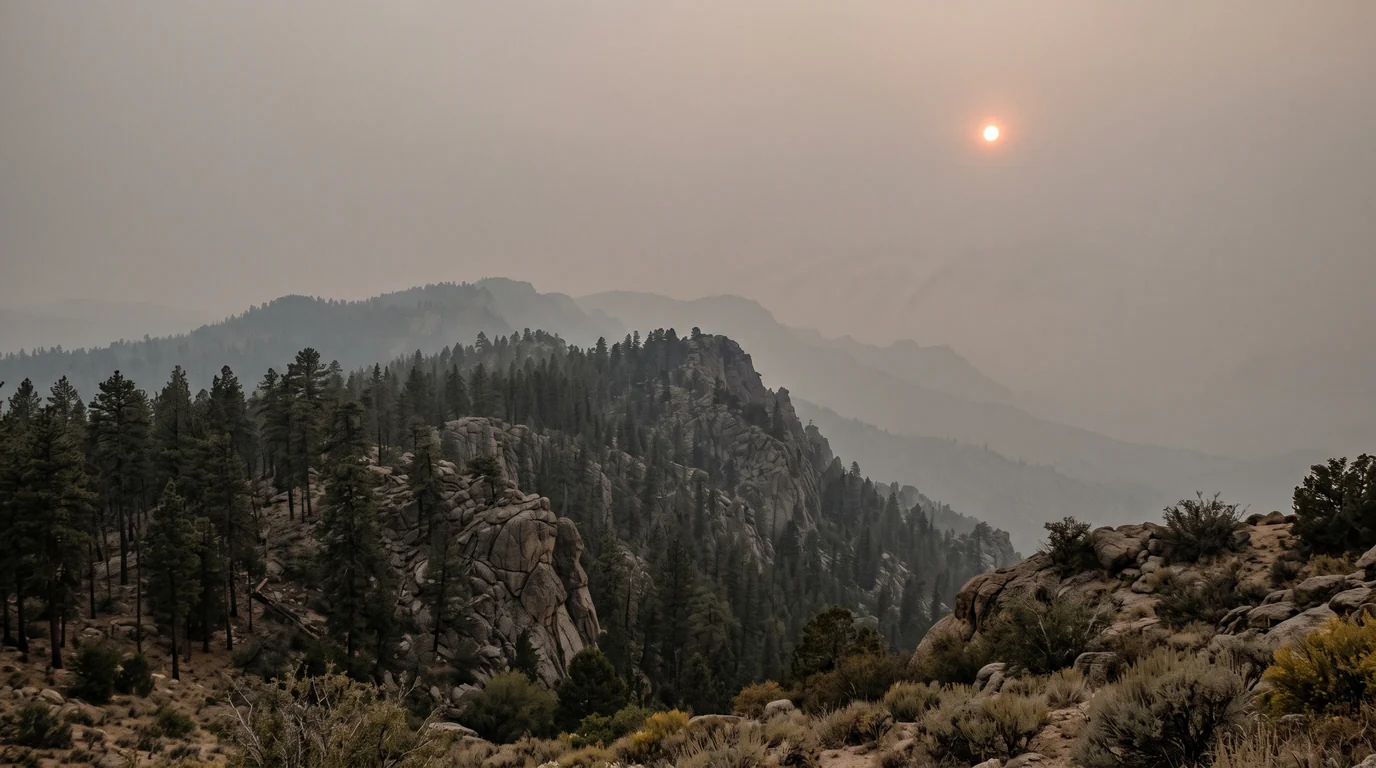
Prescott sits inside a ring of ponderosa pine. Prescott National Forest wraps the city on nearly every side, which is most of what makes living here worth it. It's also why a fire burning well outside the county can turn an afternoon sky the color of weak tea.
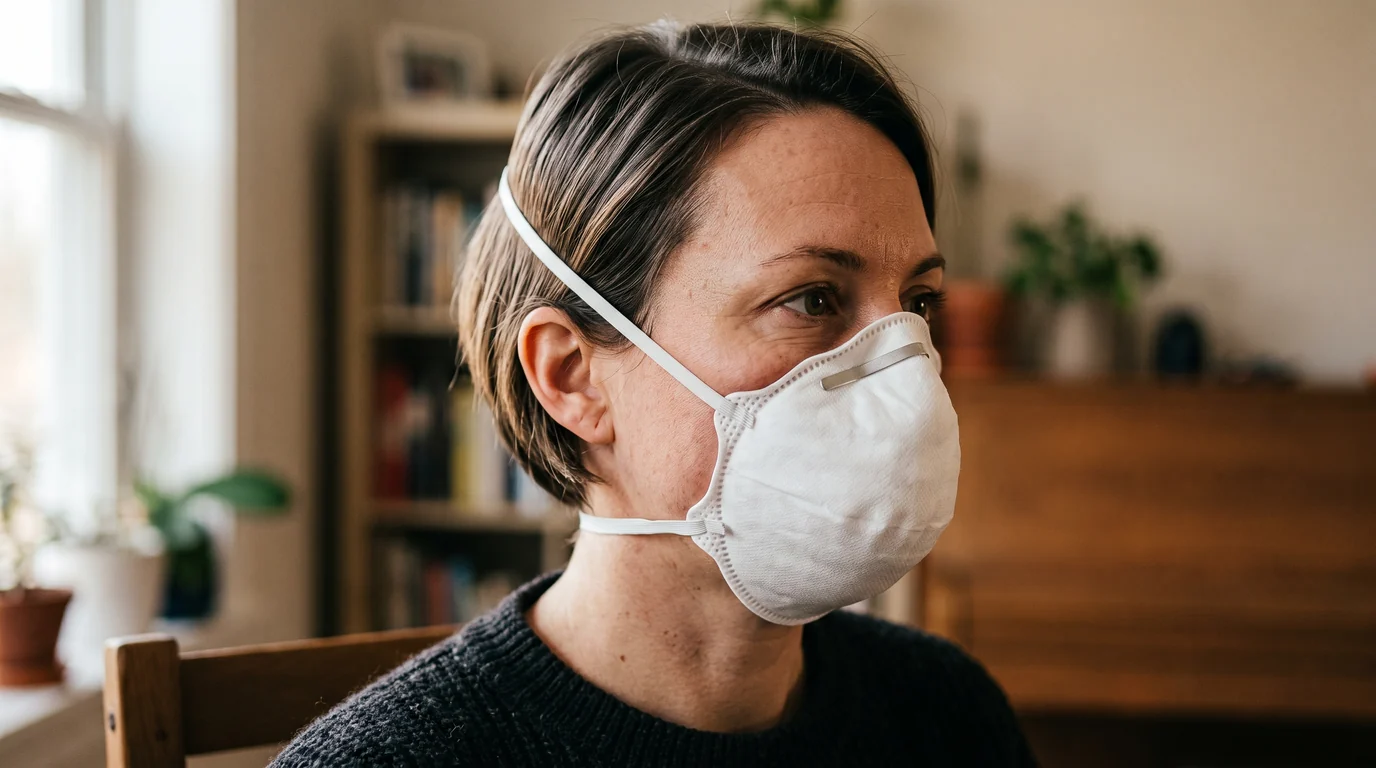
Patients ask me the same three questions every summer. Is this actually hurting me? Should I wear a mask? And does that box fan contraption my neighbor built do anything? The short answers: it depends heavily on who you are, yes but the specific mask matters far more than almost anyone realizes, and yes, until it quietly stops working.
What follows is the evidence as it actually reads, including one very large study that found close to the opposite of what its authors expected. I'll mark where the research is strong and where it's genuinely unsettled. You deserve to know which is which.
Key Takeaways
- Fit beats filter rating. Worn on real faces, N95s scored a protection factor of 165.7 versus 6.20 for KN95s, a roughly 27-fold gap driven by head straps versus earloops.
- The respiratory evidence is strong: asthma emergency visits ran 17% above expected on 2023 wildfire smoke days.
- The short-term cardiovascular evidence is genuinely mixed, and avoidance behavior may be part of the reason.
- Closing the windows is not enough. Indoor PM2.5 still reaches 55% to 60% of outdoor levels.
- DIY filter boxes work well, then fail silently. Smoke-loaded output fell to 4.3 CFM with almost nothing visible on the filter.
Why Does Wildfire Smoke Reach Prescott When the Fire Is Nowhere Near It?
Because the particles are small enough to travel like a gas. The EPA defines PM2.5 as “fine inhalable particles, with diameters that are generally 2.5 micrometers and smaller,” and puts an average human hair at about 70 micrometers, which it describes as “30 times larger than the largest fine particle” (EPA).
Particles that size don't settle out of the air quickly, and they don't stop at your throat. EPA states that “some particles less than 10 micrometers in diameter can get deep into your lungs and some may even get into your bloodstream.” Notice the hedging in that sentence. It's EPA's language, not mine, and I'd rather quote it accurately than upgrade it into a certainty it hasn't earned.
Our smoke arrives from three directions. Distant large fires elsewhere in the West, which show up as regional haze. Nearby wildfire, which shows up fast. And prescribed burning, including work by Prescott National Forest's Bradshaw Ranger District, which is planned and announced ahead of time. That third category is the one people misread most often. Prescribed fire is the tool that makes the second category less catastrophic.
Yavapai County knows what the alternative costs. The 2013 Yarnell Hill Fire killed 19 members of the Granite Mountain Hotshots (NWS Flagstaff). Fire season here also overlaps the monsoon, and the same storms that finally scrub the air produce the lightning that starts new fires. Plan for both halves of the summer: our guide to monsoon season health for Prescott residents covers the other half.
Who Is Actually at Higher Risk?
EPA names four groups, and the reasoning is physiologic rather than vague. Children rank high because “their lungs are still growing” and they “inhale more air per pound of body weight than adults” (EPA Wildfire Smoke Course). Being on the list doesn't mean you'll get sick. It means your margin is thinner.
Children
Kids breathe faster, play harder, and spend more of a smoky afternoon outdoors than anyone else in the household. Those three facts compound. There's also a practical problem I'll return to below: the respirators that seal well on adults do not seal on a child-sized face, which leaves parents with fewer good options than the internet implies.
Older Adults and People With Chronic Heart or Lung Disease
EPA's stated reason for flagging older adults is that they are “more likely to already have chronic heart or lung disease.” It's the underlying condition doing most of the work, not the birthday. On cardiovascular disease specifically, EPA writes that “smoke exposure can trigger severe cardiovascular events in people with underlying cardiovascular diseases and related conditions.” Hold that sentence in mind, because the next section complicates it.
Pregnancy
EPA notes that “changes in the body that happen with pregnancy (e.g., increased breathing rates) may increase sensitivity to smoke exposure.” The outcomes it lists are gestational diabetes, high blood pressure during pregnancy, low birth weight and preterm birth. If you're pregnant during a smoke week, the indoor air strategies further down matter more for you than the mask does, simply because you spend more hours inside than out.
What Does the Evidence Show About Smoke and Breathing?
This is where the data is strongest and least ambiguous. During the 19 wildfire smoke days between April 30 and August 4, 2023, asthma-associated emergency department visits ran 17% higher than expected nationally, drawn from a surveillance network covering roughly 4,317 emergency departments (CDC MMWR, 2023).
The age pattern is the interesting part. The largest increases were among people aged 5 to 17 and 18 to 64, not the very old. That's consistent with exposure rather than fragility. School-age kids and working adults are the people actually outside when the air goes bad.
In our practice, the patients who struggle most during a smoke week are almost never the ones with the worst lung function on paper. They're the ones whose controller inhaler ran out in April and who have been coasting on a rescue inhaler ever since. Smoke doesn't create that problem. It exposes it, usually on a Saturday.
So the practical move is unglamorous. If you have asthma or COPD, get your controller therapy and your action plan sorted in May, while the sky is still blue. Refills are easy in June and miserable in July.
The Cardiovascular Evidence Is Genuinely Mixed
Here I have to spoil a tidy narrative. A 2025 analysis in the Journal of the American Heart Association examined 49,759,958 emergency department visits across five western states including Arizona, from 2007 to 2018. Per 10 µg/m³ of smoke PM2.5, total cardiovascular ED visits showed an odds ratio of 0.997, 95% CI 0.996 to 0.998 (JAHA, 2025).
That's slightly decreased. The specific outcomes were null: acute myocardial infarction 0.999 (0.992 to 1.006), stroke 0.996 (0.985 to 1.008), atrial fibrillation 0.994, heart failure 0.995. Nobody set out to find that. The authors describe the result as unexpected.
Their proposed partial explanation is behavioral avoidance. When smoke advisories go out, people with heart disease stay inside, cancel the yard work and skip the hike. If that's what happened, the study isn't evidence that smoke is harmless. It's evidence that the countermeasures work, which is an argument for everything in the rest of this article, not against it.
Two cautions. First, mechanistic research and the long-term exposure literature still support real cardiovascular concern. The tension is specifically about short-term, acute emergency visits. Second, a study conducted during an era of active public health warnings is not the same as a study of an unwarned population. I won't tell a patient with heart failure that a smoky week is nothing. I also won't tell them the acute risk is settled, because it isn't.
How Do You Read the Air Quality Index Before You Plan Your Day?
Start by throwing out any chart printed before May 2024. EPA revised the PM2.5 breakpoints effective May 6, 2024, tightening the Good category to a 24-hour average of 0.0 to 9.0 µg/m³ (EPA). Old reference cards now understate the category for the same measured air.
| AQI | Category | Color | PM2.5 (µg/m³, 24-hr) | What it means and what I'd do |
|---|---|---|---|---|
| 0 to 50 | Good | Green | 0.0 to 9.0 | Normal activity. Go ride the Peavine. |
| 51 to 100 | Moderate | Yellow | 9.1 to 35.4 | Fine for most people. Unusually sensitive folks can shift hard exercise to early morning. |
| 101 to 150 | Unhealthy for Sensitive Groups | Orange | 35.5 to 55.4 | EPA: “Members of sensitive groups may experience health effects. The general public is less likely to be affected.” Sensitive groups move exertion indoors and run HVAC on recirculate. |
| 151 to 200 | Unhealthy | Red | 55.5 to 125.4 | EPA: “Some members of the general public may experience health effects; members of sensitive groups may experience more serious health effects.” Everyone limits outdoor exertion. Fitted N95 outdoors. Air cleaner running in the bedroom. |
| 201 to 300 | Very Unhealthy | Purple | 125.5 to 225.4 | EPA: “Health alert: The risk of health effects is increased for everyone.” Stay in. Set up a filtered clean room. N95 for any errand. |
| 301 and above | Hazardous | Maroon | 225.5 and above | EPA: “Health warning of emergency conditions: everyone is more likely to be affected.” No outdoor exertion. If you're high risk and can't filter your indoor air, consider leaving the area. |
One nuance the color chart hides: these numbers move fast. A morning that starts green in Prescott can be orange by three in the afternoon when the wind shifts. Check conditions when you're deciding, not when you woke up.
Fit Beats Filter Rating: The Mask Finding Almost Nobody Reports
Quantitative fit testing by Defence Research and Development Canada, published in PLOS ONE in 2021, found that KN95 filter material outperformed N95 filter material, with filtration protection factors of 144.5 versus 69.8. Then they measured the same masks on human faces. Worn, the N95 delivered a total inward leakage protection factor of 165.7. The KN95 delivered 6.20 (PLOS ONE, 2021).
| Mask type | Protection factor as worn | Roughly how much gets through |
|---|---|---|
| Two-layer fabric | 1.42 | About 70% |
| Multi-layer cloth | 1.78 | About 56% |
| Procedure or surgical | 2.26 | About 44.2% |
| KN95 | 6.20 | About 16.1% |
| N95 | 165.7 | About 0.60% |
That's roughly a 27-fold difference between the N95 and the KN95, and it isn't the filter media. The KN95 media was better. The gap comes down to earloops versus dual head straps. Earloops pull sideways across the cheeks. Head straps pull backward and compress the seal. Air, like water, takes the easiest path available, and a gap at the nose bridge is a very easy path.
Nearly every consumer article I've read lists “N95 or KN95” as one interchangeable option. On this data they are not close to equivalent. If you buy one thing before next fire season, buy NIOSH-approved N95s with two head straps, in the size that fits the person who'll wear them.
Beards and small faces are real problems, not footnotes. Facial hair crossing the seal surface breaks the seal, and no amount of filter quality compensates for a gap. The same is true for a child wearing an adult respirator. Quick self-check: if your glasses fog, warm air is escaping at the nose, which means smoky air is coming in somewhere too.
How Do You Actually Clean the Air Indoors?
Closing up gets you less than half the way there. EPA reports that “indoor PM2.5 levels will be around 55% to 60% of outdoor levels during wildfire smoke events when doors and windows are closed,” with an observed range of 30% to 100% (EPA). Shutting the windows is step one of three.
What Should You Do With Your HVAC System?
Upgrade the filter and run the fan continuously. EPA's numbers: a high-efficiency filter with the fan running continuously cuts indoor PM2.5 by roughly 50%, while a standard filter with the fan running continuously manages about 24% (EPA). EPA recommends MERV 13 or higher during smoky periods. Most residential systems from the last two decades handle that fine, though a very old blower may struggle with the added resistance.
Evaporative Coolers Are the Specific Yavapai County Problem
Swamp coolers are everywhere in this county, and by design they are whole-house outdoor air pumps. During a smoke event that's exactly backward. EPA's clean room guidance is blunt: “completely cover the outside air intakes with 4-inch-thick high-efficiency (MERV 13) furnace filters” (EPA).
Buy those filters in May. Not on the smoky Thursday when every hardware store between here and Cottonwood is sold out. And if the cooler is your only cooling, heat is its own medical hazard, so don't simply shut it off in July. Filter the intake, and set up one filtered bedroom as a clean room you can retreat to.
Do DIY Box Fan Air Cleaners Actually Work?
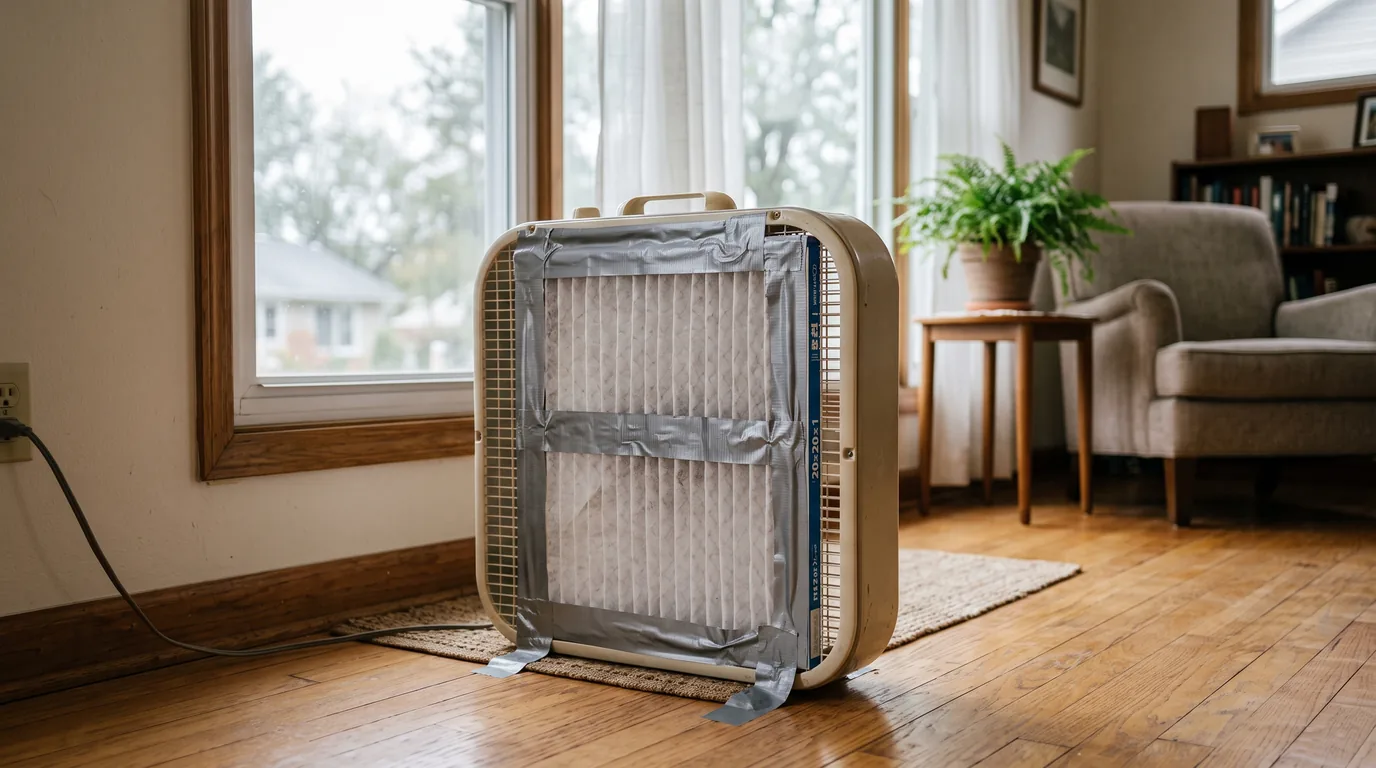
They do, and EPA's own Office of Research and Development measured exactly how well. Holder, Halliday and Virtaranta, publishing in Indoor Air in November 2022, tested a range of configurations for clean air delivery rate (Indoor Air, 2022).
| Configuration | Clean air delivery rate (CFM) |
|---|---|
| 1-inch MERV 13 taped to fan, low speed | 79.7 |
| 1-inch MERV 13 taped to fan, high speed | 111.2 |
| Same, plus a cardboard shroud | 156.1 |
| Single 4-inch MERV 13 | 247.9 |
| Two-filter wedge | 263.1 |
| Corsi-Rosenthal box, four filters | 400.9 |
Two details matter for shopping. Substituting MERV 11 for MERV 13 caused a 43% reduction in clean air delivery, so the filter rating is not a place to economize. And the cost math is lopsided: the study put the Corsi-Rosenthal box at $0.18 per CFM, against a commercial unit rated at 100 CFM priced at $123.05.
Now the part almost no article mentions, and the reason I raise it in exam rooms. In that same study, a smoke-loaded filter's clean air delivery rate fell to 4.3 CFM. From hundreds of CFM to essentially nothing. And the loaded filters showed minimal visible accumulation. A box that was doing real work on Monday may be doing close to nothing by Thursday, and it will not look dirty enough to warn you. Write the date on the filter frame with a marker. During a sustained smoke event, replace on a schedule, never on appearance.
How Much Clean Air Does the Room Need?
Size it deliberately. The familiar rule that a cleaner's CADR should equal about two-thirds of a room's square footage belongs to AHAM, not EPA, though EPA's Guide to Air Cleaners in the Home publishes a table encoding the same ratio for an 8-foot ceiling (EPA):
- 100 sq ft needs 65 CFM
- 200 sq ft needs 130 CFM
- 300 sq ft needs 195 CFM
- 400 sq ft needs 260 CFM
- 500 sq ft needs 325 CFM
- 600 sq ft needs 390 CFM
On paper, one Corsi-Rosenthal box at 400.9 CFM covers a room over 600 square feet. In a real house, with a partially loaded filter and a door that keeps opening, plan for meaningfully less. Bedrooms are the highest-value target anyway. You spend a third of the smoke event asleep in one.
One Category to Avoid Outright
Skip anything that makes ozone. EPA is direct: “Avoid portable air cleaners and furnace/HVAC filters that intentionally produce ozone. Ozone is a lung irritant.” On the devices themselves, EPA notes that “no federal government agency has approved these devices for use in occupied spaces.” If a product advertises activated oxygen, ionization or plasma, check the California Air Resources Board's certified list before you spend money on it.
Three Precautions That Don't Do What You Think
Some widely repeated advice doesn't survive contact with measurement. The clearest example is the first one below: with windows closed and nothing filtering the air, indoor PM2.5 still sits at 55% to 60% of outdoor levels, per EPA. Here are three habits worth correcting before the next smoke week.
- “Closing the windows is enough.” It isn't. Closing up is necessary and nowhere near sufficient. Pair it with a MERV 13 filter and a continuously running fan, or a portable cleaner sized to the room.
- “Houseplants clean the air.” Be careful how you state this one. The best-known research, reviewed by Drexel University in November 2019, concerned volatile organic compounds rather than particulate matter, and found the effect negligible next to ordinary air exchange, on the order of 100 to 1,000 plants per square meter to match normal building ventilation. So the honest claim is narrower than the internet's version: that work didn't study wildfire PM2.5, and no public health agency recommends houseplants for smoke. Keep the pothos. Don't count on it.
- “A bandana helps.” EPA specifically names bandanas, scarves and gaiters as not protective. The PLOS ONE two-layer fabric figure of 1.42 works out to roughly 70% of particles getting through as worn. It's a dust rag on your face, and it can encourage people to stay outside longer than they should.
Local Resources Worth Bookmarking
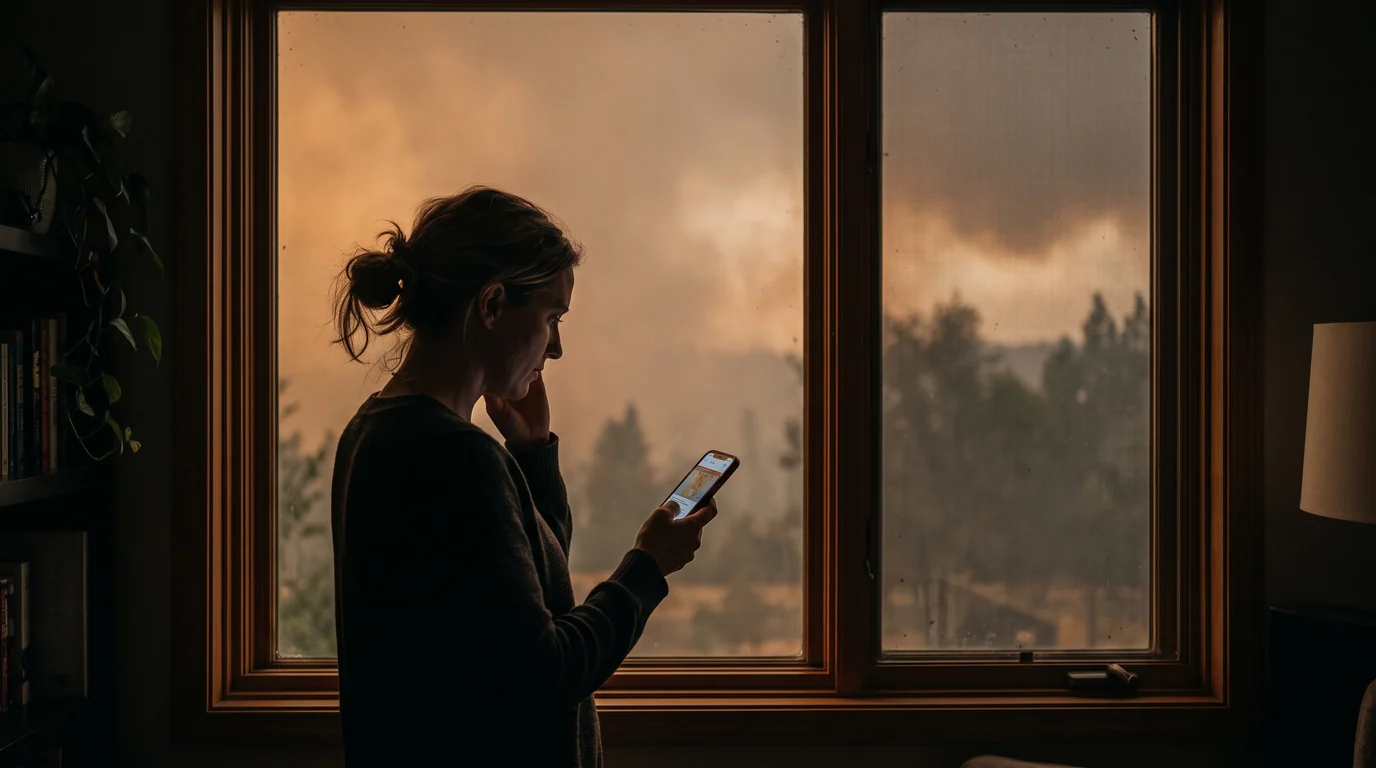
The single most useful tool is the AirNow Fire and Smoke Map, run jointly by EPA and the US Forest Service. It combines permanent regulatory monitors with thousands of quality-screened low-cost sensors, which matters enormously in a county where the nearest official monitor may sit many miles from your street.
- AirNow Fire and Smoke Map: near-real-time sensor readings and fire perimeters.
- AirNow.gov: official AQI by ZIP code.
- ADEQ air quality forecasts: next-day planning for Arizona.
- ADEQ Smoke Management: prescribed burn notifications, including Bradshaw Ranger District activity.
- CARB certified air cleaning devices: check any purifier against this list for ozone safety.
When Should You Call a Doctor?
Sooner than most people do. EPA's language about the highest-risk group is unambiguous: “Smoke exposure can trigger severe cardiovascular events in people with underlying cardiovascular diseases and related conditions.” If you have asthma, COPD, heart failure or coronary disease, the most valuable conversation happens before the smoke, not during it.
Call 911 rather than the office for chest pain or pressure, sudden shortness of breath at rest, confusion, or an asthma flare that isn't responding to a rescue inhaler. Those are not wait-and-see situations, smoke or no smoke.
Call your physician the same week if you're reaching for a rescue inhaler more than twice a week, waking at night short of breath, or noticing that your usual walk has gotten hard. Those are early signals, and early is where they're cheap to fix. At Prescott Professional Healthcare we'd rather field the small question in June than the emergency in July, so if you're unsure whether something warrants a call, it warrants a call.
None of this takes heroics. A well-fitted N95 with head straps. A filter you actually replace on schedule. A plan for the swamp cooler. And the habit of checking the Fire and Smoke Map before you commit to the afternoon hike. That's most of the available benefit, and it costs a couple of hours in the spring. The forest around Prescott is going to keep burning, sometimes deliberately and for good reason. We can be ready for it.
Frequently Asked Questions
Is a KN95 as good as an N95 for wildfire smoke?
No. In quantitative fit testing published in PLOS ONE in 2021, N95s worn on real faces reached a total inward leakage protection factor of 165.7 versus 6.20 for KN95s, roughly 27-fold. The KN95 filter material actually tested better. Earloops simply cannot hold a seal the way dual head straps do.
What AQI number should keep me indoors in Prescott?
Under EPA's 2024 breakpoints, AQI 101 to 150 (35.5 to 55.4 µg/m³) is Unhealthy for Sensitive Groups, so children, older adults, pregnant patients and anyone with heart or lung disease should move exertion indoors. At 151 and above, EPA says some members of the general public may experience health effects.
Does wildfire smoke cause heart attacks?
The short-term evidence is more mixed than headlines suggest. A 2025 Journal of the American Heart Association study of 49,759,958 western emergency visits, Arizona included, found an odds ratio of 0.999 for acute heart attack per 10 µg/m³ of smoke PM2.5, a null result. Long-term and mechanistic research still supports real concern.
Do DIY box fan air cleaners actually work?
Yes, measurably. EPA researchers recorded 400.9 CFM from a four-filter Corsi-Rosenthal box and 247.9 CFM from a single 4-inch MERV 13 filter. But a smoke-loaded filter's output collapsed to 4.3 CFM with minimal visible dirt, so replace filters on a schedule rather than by appearance.
What should I do about my evaporative cooler during a smoke event?
Swamp coolers pull outdoor air through the whole house by design, which is the opposite of what you want. EPA's clean room guidance says to completely cover the outside air intakes with 4-inch-thick high-efficiency MERV 13 furnace filters. Buy those filters early in the season, not during the event itself.
Will houseplants help with wildfire smoke?
No public health agency recommends them for smoke. The widely cited research, reviewed by Drexel University in November 2019, examined volatile organic compounds rather than particulate matter, and found you would need roughly 100 to 1,000 plants per square meter to match ordinary building ventilation. Use a filter instead.