
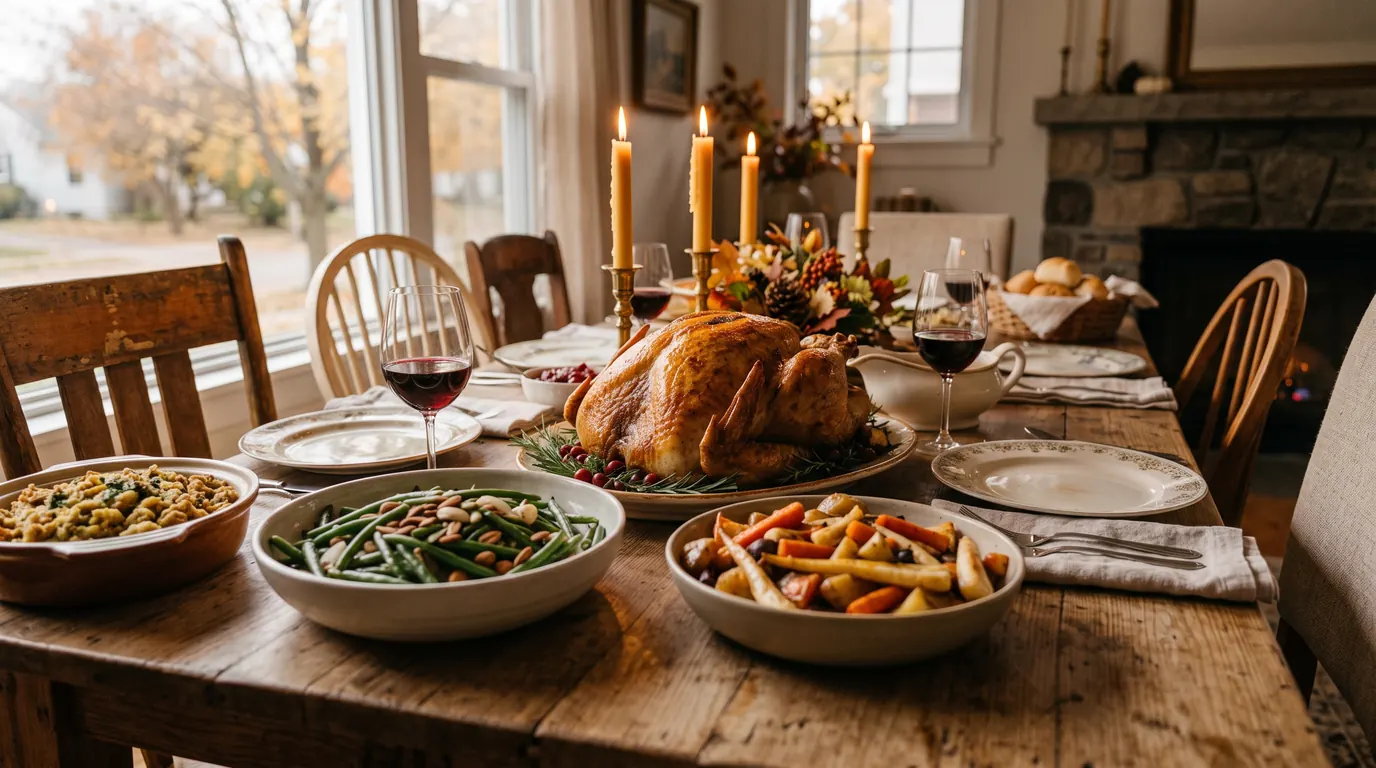
The measured holiday weight gain is 0.8 pounds, not five. The catch is that it's never lost. Here's how to enjoy Thanksgiving dinner with diabetes or high blood pressure, without skipping it.
Every November I have some version of the same conversation. Someone with type 2 diabetes or high blood pressure sits down across from me and asks, a little sheepishly, what they're allowed to eat on Thanksgiving. Underneath the question is usually a plan to skip the meal, white-knuckle it, or give up entirely until January.
I want to offer a different plan. The research on holiday eating is better than most people realize, and it says something surprisingly kind: the damage is far smaller than you fear. It also says something you should take seriously, which is that the small damage tends to stick around. Both are true, and together they point toward strategy instead of panic.
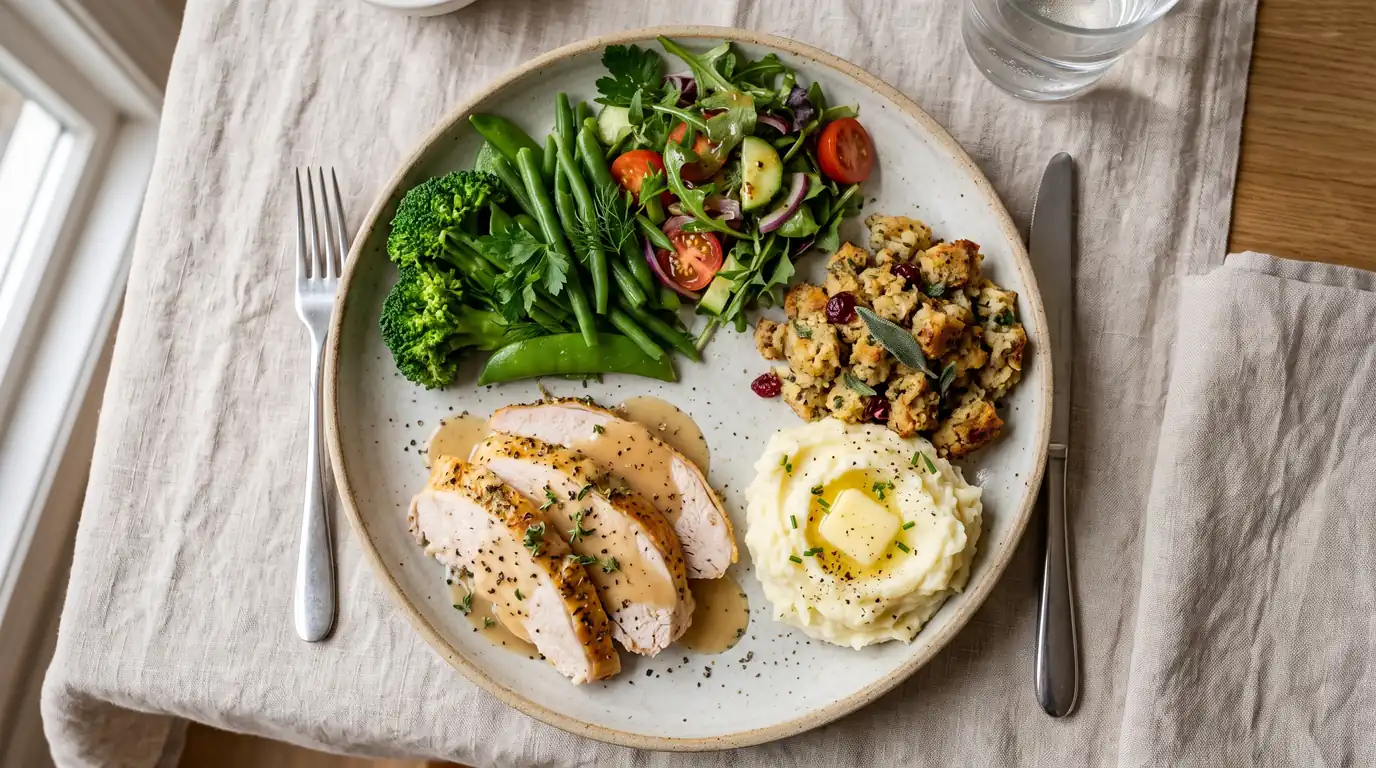
What follows covers the six weeks between Thanksgiving and New Year's Day, handled specifically. It is not a general lecture on healthy eating. If you want the year-round version, that's our practical guide to managing type 2 diabetes in retirement. This is about the table itself.
Key Takeaways
- Measured holiday weight gain averages 0.37 kg, not five pounds (Yanovski, NEJM 2000).
- But it is never lost. That annual ratchet is the real problem.
- Protein and vegetables before carbohydrate cut glucose peaks by 54%.
- Walk ten to fifteen minutes after dinner. Two trials agree.
- On insulin or a sulfonylurea? Alcohol can drop your sugar 13 hours later.
Do You Really Gain Five Pounds Over the Holidays?
No. When researchers weighed adults repeatedly across an actual holiday season, average gain was 0.37 kg, about eight tenths of a pound (Yanovski et al., New England Journal of Medicine, 2000). The authors opened by noting that the five-pound figure is “commonly asserted,” yet “few data support this statement.”

So the meal is not the catastrophe. Here's the part almost nobody reports, though, and it matters more than the headline. Those same participants were followed for a full year. Net weight gain from September or October to February or March was 0.48 kg (P=0.003), and it did not come off. There was no significant change across the rest of the year. The authors concluded that this pattern “probably contributes to the increase in body weight that frequently occurs during adulthood.”
Read the two findings together and you get an honest framing. Holiday weight gain is far smaller than you fear, and it is essentially permanent. Half a kilogram a year, never given back, is how a person quietly gains ten pounds over two decades. The enemy is the annual ratchet, not the plate in front of you.
The finding also replicates. A randomized trial run over Christmas found the comparator group gained 0.37 kg, almost exactly matching the American figure eighteen years later in a different country (Mason et al., BMJ, 2018). The intervention group actually lost 0.13 kg, an adjusted difference of negative 0.49 kg. What was the intervention? Weighing yourself regularly, writing the number down, and a short list of tips. That's it.
I find that genuinely encouraging, and I say so in the exam room. The behavior that prevents the ratchet isn't restraint at dinner. It's a bathroom scale and a pen in early January.
Does the Order You Eat Your Food Change Your Blood Sugar?
Yes, substantially. In adults with type 2 diabetes, eating protein and vegetables first and saving carbohydrate for last cut the incremental glucose area under the curve by 53% and the glucose peak by 54%, compared with eating carbohydrate first (Shukla et al., BMJ Open Diabetes Research and Care, 2017).
Same food. Same amount. Different order. Compared with eating everything together, which is what most of us do at a holiday table, carbohydrate-last still reduced the glucose area under the curve by 44% and the peak by 40%.
This has since been confirmed outside the lab. Using continuous glucose monitors in people going about ordinary life, a carbohydrate-last pattern raised time in range to 84.8% compared with 78.6% (Touhamy et al., Diabetes Care, 2025). That is a real difference produced by sequencing rather than subtraction.
Which is why I like this finding so much. It's the rare piece of diabetes advice that doesn't ask you to give anything up. You still eat the stuffing. You just eat it after the turkey and the green beans instead of before.
| Order | On a Thanksgiving plate |
|---|---|
| First | Salad, green beans, roasted Brussels sprouts, the vegetable nobody fights over |
| Second | Turkey, ham, cheese, nuts, anything mostly protein or fat |
| Last | Stuffing, mashed potatoes, rolls, cranberry sauce, sweet potato casserole, pie |
A practical note for a buffet line: load vegetables and protein onto the first plate, then treat starches and dessert as a genuinely separate course ten or fifteen minutes later. The gap is the point, and conversation at the table does most of that work for you.
The Ten-Minute Walk That Does More Than You Would Expect
Walking ten minutes after each main meal beat a single 30-minute daily walk for lowering post-meal glucose, and the effect was strongest after the evening meal: a ratio of 0.78 (95% CI 0.67 to 0.91), roughly a 22% reduction (Reynolds et al., Diabetologia, 2016).
A second trial found the same thing in exactly the population that eats Thanksgiving dinner at three in the afternoon and then sits down. In adults aged 60 and older, three 15-minute post-meal walks improved 24-hour glucose control and were significantly more effective than 45 minutes of sustained walking for lowering post-dinner glucose (DiPietro et al., Diabetes Care, 2013).
Two independent trials, different designs, same conclusion. Short and soon beats long and later. That's an unusual level of agreement for a lifestyle intervention, and it's why this is the suggestion I make most often in November.
So here is the whole prescription: eat the meal you want, then walk for ten to fifteen minutes. Around the block, to the end of the street, a slow loop with whoever will come along. In Prescott that walk is cold and dark by late afternoon in November, so set a coat by the door before dinner starts. Removing the friction is most of the battle.
Why Does Alcohol Cause Low Blood Sugar the Next Morning?
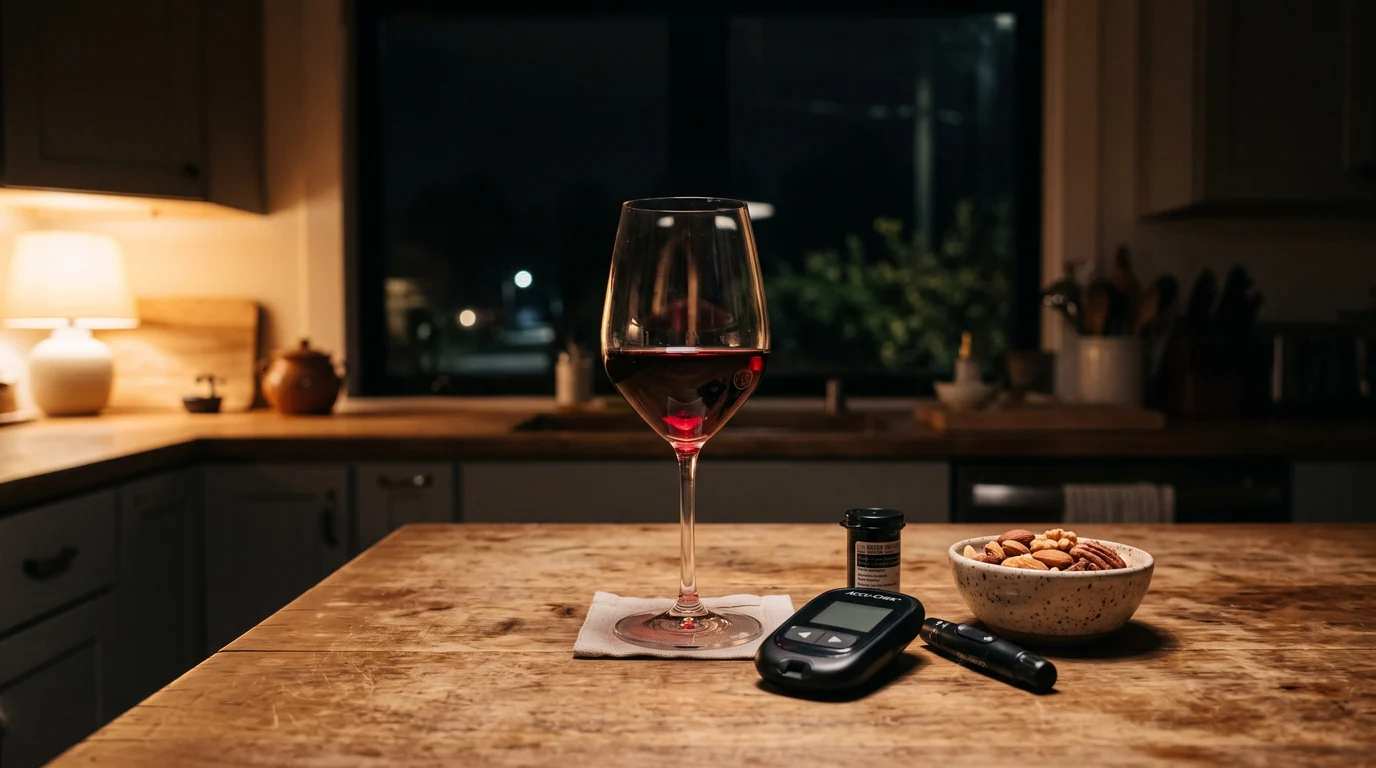
Not the way most articles describe it. For anyone on insulin or a sulfonylurea, the documented danger is delayed hypoglycemia, and the delay is long. In a small controlled study of six men with type 1 diabetes, wine at 9 PM left five of six participants needing treatment for low blood sugar starting at 10 the next morning, roughly 13 hours later (Turner et al., Diabetes Care, 2001).
The proposed mechanism is suppression of overnight growth hormone secretion. It was a small study, so hold the exact numbers loosely. The direction, though, is well recognized. The American Diabetes Association's 2026 Standards of Care recommend counseling on “the signs, symptoms, and self-management of delayed hypoglycemia and the importance of monitoring glucose after drinking alcohol... especially when using insulin or insulin secretagogues” (American Diabetes Association, 2026).
There's a second problem that compounds the first. Alcohol blunts your ability to feel a low coming on. The early warnings you rely on, the shakiness and the sweat and the odd irritability, arrive muted or not at all. A delayed low plus a dulled alarm is the combination that actually lands people in trouble.
None of that means you can't have a glass of wine. ADA limits are up to two drinks a day for men and one for women, where one drink means 12 ounces of beer, 5 ounces of wine, or 1.5 ounces of spirits. The rules that matter:
- Never drink on an empty stomach. Eat when you drink.
- Check your glucose before bed, not just before the first drink.
- Check again in the morning, even if you feel fine.
- Make sure someone in the house knows you take insulin or a sulfonylurea.
How Much Sodium Is Too Much During the Holidays?
Sodium moves blood pressure quickly. In the DASH-Sodium trial, cutting sodium from the intermediate to the low level lowered systolic blood pressure by 4.6 mmHg, and the DASH diet at low sodium versus a control diet at high sodium produced an 11.5 mmHg systolic drop in people with hypertension (Sacks et al., NEJM, 2001).
An 11.5 mmHg difference is larger than what many people get from adding a second blood pressure medication. Diet is not a soft intervention here. The National Heart, Lung, and Blood Institute sets the DASH target at 2,300 mg of sodium daily and notes that 1,500 mg lowers blood pressure further (NHLBI).
If you have heart failure, this is the most important section in the article. In one study, 22% of heart failure exacerbations were precipitated by not following salt restriction (Tsuyuki et al., Archives of Internal Medicine, 2001). Roughly one in five. The advice I give my own heart failure patients through December: weigh daily, and call if you gain two or three pounds in a couple of days or your shoes stop fitting.
The practical problem is that holiday sodium mostly isn't in the salt shaker. It's in the brine, the canned broth in the stuffing and gravy, the boxed stuffing mix, the cured ham, the olives and pickles on the relish tray, and the crackers and cheese you eat standing up before dinner is served. Two changes do most of the work: use low-sodium broth wherever a recipe calls for broth, and pick one salty appetizer instead of grazing the whole tray.
Holiday Heart Syndrome Is Real, and It Has a Publication Date
The term comes from a 1978 paper describing patients hospitalized with atrial fibrillation after weekend drinking binges. Alcohol-induced atrial fibrillation typically appears 12 to 36 hours after heavy drinking, and in more than 90% of cases it resolves on its own within 12 to 24 hours (StatPearls).
The modern evidence here is unusually strong, because researchers stopped relying on what people said they drank. Using objective alcohol sensors and continuous heart monitoring, in people who already have paroxysmal atrial fibrillation, one drink in the preceding four hours roughly doubled the odds of an episode (odds ratio 2.02), and two or more drinks more than tripled them (odds ratio 3.58) (Marcus et al., Annals of Internal Medicine, 2021).
Notice how low that threshold sits. One drink. This is the finding I'd want you carrying into December if you already have atrial fibrillation, or if you've ever been told your heart slipped into an odd rhythm.
What it feels like: fluttering or racing in the chest, a pulse that has lost its beat, light-headedness, or unusual shortness of breath. Most episodes stop by themselves, and that is still not a reason to wait it out alone. If it lasts more than a few hours, if you feel faint, or if chest pain comes with it, that's an emergency room visit rather than a wait-and-see.
Why Do Heart Attacks Peak on Christmas Eve?
Among people who die before reaching a hospital or shortly after arriving, cardiac deaths run 4.65% above expected during the holiday period, with twin peaks at Christmas and New Year (Phillips et al., Circulation, 2004). In a Swedish registry of 283,014 heart attacks, Christmas Eve carried an incidence rate ratio of 1.37, a 37% higher risk (Mohammad et al., BMJ, 2018).
Nobody has proven why. Researchers have proposed several contributors, including emotional stress, changes in diet and alcohol, cold exposure, and delayed care-seeking. Proposed is the right word. These remain hypotheses, not settled findings.
The practical point stands on its own regardless. Do not wait until Monday. Do not wait until the family goes home. Do not decide on your own that it's indigestion, because pressure, squeezing, burning, or fullness in the chest is exactly what a heart attack feels like for plenty of people, and it can show up instead as jaw pain, arm pain, nausea, sudden sweating, or breathlessness. If it feels like chest pain, it isn't indigestion until someone qualified says so. Call 911.
I would rather see you in the emergency department on Christmas Eve and be wrong than have you talk yourself out of going. That isn't a polite thing doctors say. It's the actual math of the situation.
Does Short Sleep Make Blood Sugar Harder to Control?
It appears to, and the mechanism is well described. In a small laboratory study of healthy young men, six nights restricted to four hours of sleep measurably reduced glucose tolerance and raised evening cortisol (Spiegel et al., The Lancet, 1999).
That study was small and its participants were young and healthy, so treat it as mechanism rather than a population estimate. It does explain something patients describe to me every January, though: numbers that drifted upward during a stretch when the food changed less than the schedule did.
December compresses sleep from both ends. Late gatherings, early travel, houseguests in the spare room, a grandchild who wakes at five. If you're going to lose sleep somewhere in these six weeks, lose it deliberately on two or three nights rather than accidentally on fifteen.
Disrupted routines cut the same way for medication. This is clinical judgment rather than cited guidance, but in my experience the most common December problem isn't a dessert. It's a missed dose, because the pill bottle lives next to the coffee maker at home and the coffee maker is four hundred miles away. If your schedule is about to change, talk with your own physician ahead of time about keeping your regimen intact.
A Six-Week Plan You Can Actually Follow
The strategy that worked in a randomized trial was almost embarrassingly simple: weigh yourself regularly, record the number, and follow a few brief tips. That group lost 0.13 kg over Christmas while the comparator group gained 0.37 kg (Mason et al., BMJ, 2018). Awareness, not restriction.
At the table
- Vegetables and protein first. Starches and dessert last, ideally as a separate course.
- Eat before you drink, and count your drinks honestly.
- Choose one salty appetizer rather than grazing the relish tray.
- Have the pie. One piece, after dinner, not instead of it.
After the table
- Ten to fifteen minutes of walking after the main meal. Bring somebody with you.
- Check glucose at bedtime if you drank, and again in the morning.
- With heart failure, weigh daily and act on a two to three pound jump.
The part that actually matters
Step on the scale in the first week of January and write the number down. That's the whole intervention. The Yanovski data says the holiday pound is small, and it also says the pound stays. Catching it in January is what breaks the yearly ratchet, and it takes about nine seconds.
If your last A1c or lipid panel was a blur of numbers you nodded at, these six weeks are a good time to actually understand them. We wrote a plain-language walkthrough of what those lab numbers actually mean, and knowing your own baseline makes January far less abstract.
Eat the Dinner
The evidence points in one direction, and it isn't the direction most holiday health articles go. Skipping Thanksgiving dinner buys you eight tenths of a pound. Eating it in a smarter order, walking afterward, and being careful with alcohol and salt buys you most of the metabolic benefit while leaving the holiday intact.
What's worth guarding isn't the meal. It's the drift: the pound that never leaves, the December when the walking stopped, the January nobody weighed themselves. Handle those and the turkey takes care of itself.
If your diabetes or blood pressure feels harder to manage than it should, or you'd like a plan built around your own numbers before the season starts, reach out to the office at Prescott Professional Healthcare. That kind of unhurried conversation is exactly what our visits are for.
Please note: This article is educational and is not medical advice. Talk with your own physician before changing medication, diet, or alcohol use, particularly if you take insulin or a sulfonylurea.
Frequently Asked Questions
How much weight do people actually gain over the holidays?
Far less than the popular five pounds. The measured average is 0.37 kg, roughly 0.8 pounds (Yanovski, NEJM 2000). The catch is that this weight is not lost over the following year, so small annual gains accumulate across adulthood. That is why weighing yourself in January matters.
Can I eat pie if I have type 2 diabetes?
Yes, with sequencing. Eating protein and vegetables before carbohydrate reduced glucose peaks by 54% versus carbohydrate first (Shukla, BMJ Open Diabetes Research and Care 2017). Eat dessert after the meal rather than in place of it, keep it to one piece, then walk for ten to fifteen minutes.
What is the best exercise after a big holiday meal?
A ten to fifteen minute walk. Ten minutes after each meal beat one 30-minute daily walk, with the largest effect after the evening meal, roughly a 22% reduction (Reynolds, Diabetologia 2016). In adults over 60, short post-meal walks outperformed 45 minutes of sustained walking for post-dinner glucose.
Is it safe to drink alcohol if I take insulin?
With precautions. Alcohol can cause delayed hypoglycemia. In a small controlled study of men with type 1 diabetes, evening wine led five of six subjects to need treatment for low blood sugar the next morning, about 13 hours later (Turner, Diabetes Care 2001). Never drink on an empty stomach, and check glucose at bedtime and morning.
How much sodium should I aim for during holiday meals?
NHLBI's DASH target is 2,300 mg daily, noting that 1,500 mg lowers blood pressure further. Reducing sodium lowered systolic pressure by 4.6 mmHg in the DASH-Sodium trial (Sacks, NEJM 2001). Most holiday sodium hides in broth, brine, stuffing mix, cured ham, and appetizers, not the salt shaker.
What is holiday heart syndrome and should I worry about it?
It is atrial fibrillation triggered by heavy drinking, first described in 1978. Episodes usually appear 12 to 36 hours afterward and resolve on their own within 12 to 24 hours in over 90% of cases. In people who already have paroxysmal AF, one drink within four hours roughly doubled episode odds (Marcus, Annals of Internal Medicine 2021).