
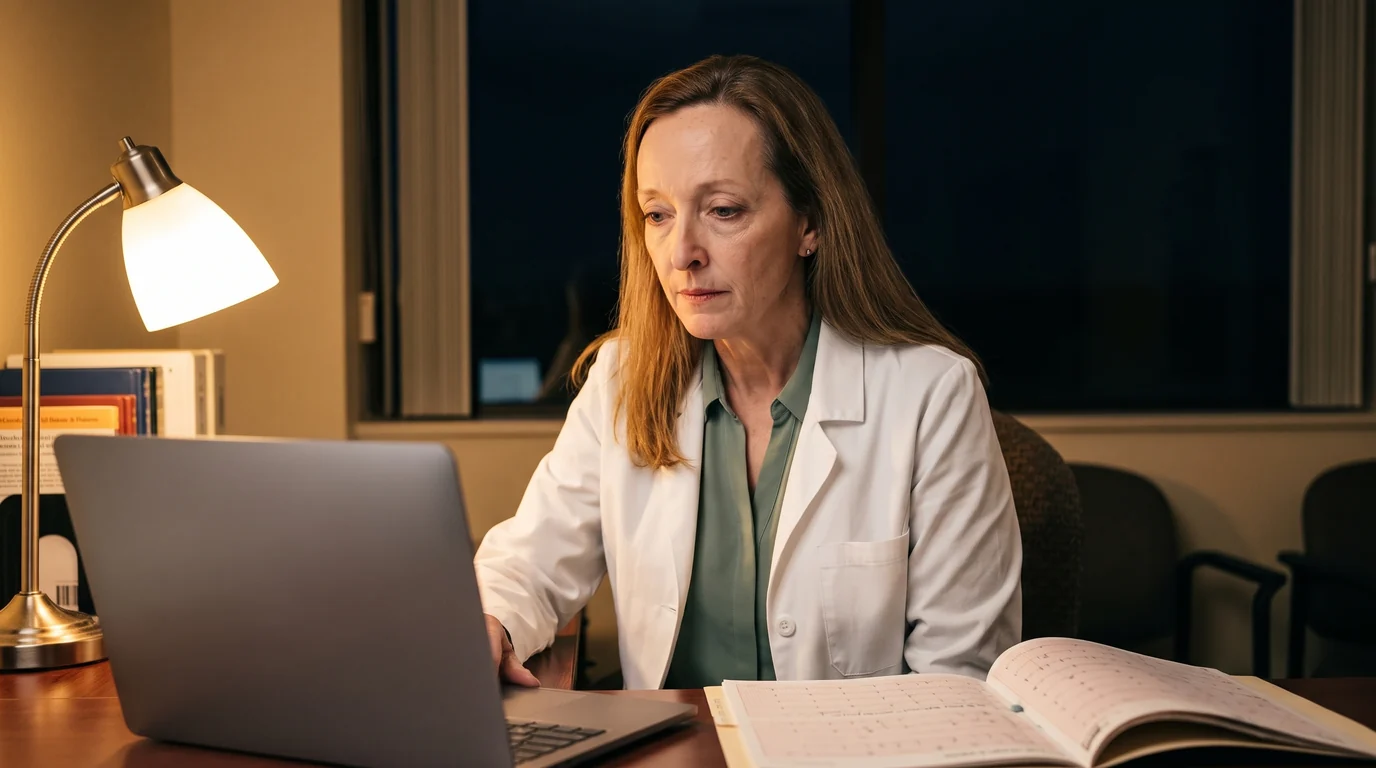
For every 30-minute visit, doctors average 36.2 minutes in the medical record. A look at the invisible half of primary care, and why your appointment is closer to a receipt than the care.
A patient asked me last year, very pleasantly, what I do on the days I'm not seeing patients. She wasn't being pointed about it. She had looked at the schedule, done the arithmetic, and assumed I was somewhere on Thumb Butte with a thermos. I wish. The honest answer is that those hours are when I do the half of this job that never gets a calendar entry, never gets a room number, and never gets shown to anyone.
Here's the number that reframes the whole conversation. For a single 30-minute scheduled visit, primary care physicians averaged 36.2 minutes of electronic health record time (Rotenstein et al., JAMA Network Open). Of that, 7.8 minutes was inbox work and 6.2 minutes happened after hours. Read that again. The appointment is the shorter half of the appointment.
Most patients carry a reasonable and completely incorrect model of how primary care works: the appointment is the care. In practice, the appointment is closer to the receipt. It's the time-stamped, documented, billable record of a much larger process that happens while you're not in the room. Almost none of that process is visible to you, and I've come to think the invisibility itself is causing problems.
Key Takeaways
- A 30-minute visit averages 36.2 minutes of record work around it (JAMA Network Open).
- Direct patient care fills under half of a physician's 57.8-hour week (AMA, 2024).
- Patient portal messages rose 153% since 2020. They added work rather than replacing it.
- Prior authorization takes 13 hours of physician and staff time per physician each week, and 95% of physicians say it delays care.
How Much Work Happens Between Your Visits?
Roughly as much as happens during them, and frequently more. Across 307 physicians in 31 practices, total EHR time per 30-minute visit ranged from 23.5 to 47.9 minutes, and after-hours time ranged from 1.7 to 13.1 minutes. How a practice is organized changes the invisible workload by roughly eightfold.
That eightfold spread is the part I find genuinely startling. Same medicine. Same patients. Same software, in most cases. The difference between a doctor doing 1.7 minutes of after-hours work per visit and one doing 13.1 minutes isn't skill or speed. It's staffing, message routing, and who touches a refill request before the physician does. The workload isn't fixed. It's designed, usually by accident.
So what fills those minutes? Before you arrive, someone pulls your outside records and reads the cardiologist's note from March. During the visit, someone documents. After you leave, someone sends the referral, chases the imaging authorization, reviews the results that come back three days later, answers your follow-up question, and renews the prescription your pharmacy requested on a Saturday. You experience one appointment. The chart experiences about nine separate events.
The Appointment Is the Receipt, Not the Care
Direct observation confirms this. In a time-and-motion study of 57 physicians across four states covering 430 hours, doctors spent 27.0% of the office day on direct clinical face time and 49.2% on EHR and desk work (Sinsky et al., Annals of Internal Medicine, 2016). Even inside the exam room, face time was 52.9% and record work 37.0%.
"For every hour physicians provide direct clinical face time to patients, nearly 2 additional hours is spent on EHR and desk work within the clinic day." (Sinsky et al., Annals of Internal Medicine, 2016)
Here's the part worth pausing on, because a single study is a finding and a replication is a fact. The AMA's 2024 Organizational Biopsy surveyed roughly 18,000 physicians and found an average 57.8-hour workweek: 27.2 hours of direct patient care, 13 hours of indirect patient care (order entry, documentation, interpreting results, referrals), and 7.3 hours of administrative tasks. Direct patient care is 27.2 of 57.8 hours. Under half.
A self-reported survey of 18,000 physicians in 2024 and a stopwatch study of 57 physicians in 2016 used almost nothing in common methodologically. They landed on the same shape: direct patient care is the minority of the job in both. That's not a quirk of one clinic or one bad EHR vendor. That's the structure of the job. If you've ever wondered why your visit felt rushed, this is the arithmetic underneath it.
What Happens to Your Lab Results After You Leave?
They land in an inbox that already consumes about 85 minutes a day. Using Epic event logs from 142 family physicians over three years, researchers found primary care doctors spent 355 minutes (5.9 hours) in the EHR per weekday: 269 minutes during clinic hours and 86 minutes after them (Arndt et al., Annals of Family Medicine, 2017).
The breakdown matters. Clerical and administrative work, meaning documentation, order entry, billing and coding, took 157 minutes, or 44.2% of total EHR time. Inbox management took 85 minutes, 23.7%. That 86 minutes of after-clinic work has an unlovely nickname in medicine: pajama time. It is exactly what it sounds like, and it's where a lot of results review actually happens.
Your result doesn't grade itself. Somebody opens it, compares it to the one from eighteen months ago, checks it against the medication you started in June, decides whether the trend matters, and then decides how to tell you. That decision takes real thought, and it takes place entirely offstage. It's also why a normal-looking number sometimes prompts a call, which is a longer story about what those numbers actually mean.
Why Does "No News Is Good News" Feel Like Nobody Looked?
Because the contact channel changed and patients can't hear the new one. Comparing pre-pandemic data to 2022-23, the same research group found time in orders rose 58.9%, inbox time rose 24.4%, and work outside scheduled hours on non-clinic days rose 19.9%. Meanwhile portal messages received rose 55.5% while patient phone calls fell 10.5%.
Sit with that pair for a second. Calls down. Messages up. A larger analysis of Epic Cosmos data covering more than 8 billion encounters found patient-authored portal messages rose 153% from 2020 to 2025, going from 0.99 to 2.50 per patient per year, while office visits rose only 17% and telephone encounters fell 6% (JAMA, 2026).
This is the misunderstanding I'd most like to correct, because patients are drawing exactly the wrong conclusion from their own experience. You feel like you're bothering the practice less than you used to. You called twice in 2019 and you haven't called since. But you've messaged eleven times, and each message is a small clinical decision with your name on it. You're contacting us far more. It simply doesn't ring anymore.
Messaging added work instead of replacing it, and the cost is measurable. Physicians in the highest message-volume quartile had more than six times greater odds of burnout than those in the lowest quartile. US physicians receive three times more inbox messages than physicians anywhere else in the world. Please keep messaging. Just understand that the silence isn't neglect. It's triage.
The 26.7-Hour Day
My favorite absurd number in all of medicine comes from a 2022 modeling study. Delivering every piece of guideline-recommended care to a standard 2,500-patient panel would require 26.7 hours per day (Porter et al., Journal of General Internal Medicine). A day contains 24 hours. That is not a rounding error.
The breakdown is 14.1 hours of preventive care, 7.2 hours of chronic disease management, 2.2 hours of acute care, and 3.2 hours of documentation and inbox work. Notice that prevention, the thing everyone agrees we should do more of, is more than half the total and the first thing to fall off the table when a day is compressed into eleven minutes per patient.
There's a genuinely useful finding buried in that study, though. With full team-based care, where nurses, pharmacists, and staff work at the top of their training, the physician's own share drops to 9.3 hours. Still a long day. But a possible one. That's the difference between a workload problem and an arithmetic problem, and it explains why practice design matters more than physician effort.
Why Was Your Medication Denied, and Why Didn't Your Doctor Fight It?
This is the section where the absurdity stops being funny. In the AMA's 2025 Prior Authorization Physician Survey of 1,000 practicing physicians, fielded in December 2025, practices reported completing 40 prior authorizations per physician per week, consuming 13 hours of physician and staff time. Forty percent of physicians have staff working exclusively on prior authorization.
| What physicians reported (AMA, 2025) | Share |
|---|---|
| Prior authorization delays access to necessary care | 95% |
| It at least sometimes leads patients to abandon recommended treatment | 79% |
| Denials have increased over the last five years | 74% |
| It has led to a serious adverse event for a patient in their care | 26% |
| They always appeal an adverse decision | 21% |
One in four physicians reports that prior authorization has led to a serious adverse event for a patient in their care. That's not an inconvenience statistic. That's a harm statistic, self-reported by the people who watched it happen.
Why doctors sometimes don't appeal
Only 21% always appeal an adverse decision, which looks like surrender until you see the reasons. Among physicians who don't appeal, 59% don't believe the appeal will succeed, 52% lack the staff time, and 49% say the patient's care cannot wait for the health plan. That last figure is the whole system in one line. The delay is the denial.
When I choose a different medication instead of appealing, it can look like I gave up on the first one. What's actually happening is a calculation: your blood pressure needs treating this month, the appeal takes four to six weeks, and the second-choice drug is imperfect but available today. That's not my clinical judgment about what's best. It's my clinical judgment about what's reachable.
The telephone is still the main tool
Here's the detail I can't get over. Physicians report the telephone as the most commonly used method for completing prior authorizations. Only 24% say their EHR offers electronic prior authorization for prescriptions. In 2026, the primary interface between your doctor and your insurance coverage is a person on hold. I have listened to a great deal of hold music. I could review the catalog.
So the third thing patients misunderstand: a denied medication is not your doctor's decision, and it isn't your doctor's mistake. Nobody in the exam room denied anything. The decision happened somewhere else, on a timeline nobody in the room controls.
What Does the Paperwork Actually Cost?
Billing and insurance-related activities consume 13 minutes and $20.49 per primary care visit, which is 14.5% of professional revenue (Tseng et al., JAMA, 2018). An emergency department visit runs 32 minutes and $61.54. This was measured at a large academic system using a certified EHR, which is precisely the point: that's the optimized case.
Zoom out and the figure stops being a practice-level annoyance. US health care administration cost $812 billion in 2017, or 34.2% of total health expenditures, working out to $2,497 per person compared with $551 per person in Canada (Himmelstein et al., Annals of Internal Medicine, 2020). A third of the money goes to the machinery of moving the money.
What Changes When a Practice Doesn't Bill Insurance?
The category disappears rather than shrinks. A 2017 survey of direct primary care practices found that 11% submitted bills to insurance in 2015, down from 75% in 2005. Ninety-four percent had fewer than six employees, and 33% had a single staff member. Those two findings are the same finding, viewed from different ends.
A practice that doesn't bill insurance doesn't do most of those 13 minutes and doesn't lose most of that 14.5%. Collecting a monthly membership fee is not free, but it isn't claims processing either. That's not a claim about better medicine. It's subtraction. I'd rather let the earlier numbers make that argument than make it myself.
Being straight with you: it doesn't erase everything above. My patients still have insurance for imaging, specialists, hospitals, and most medications, so prior authorization still shows up, and I still spend time on hold. The inbox still fills. What changes is that one large, unavoidable category of work stopped existing here, and those hours went somewhere.
What This Means the Next Time You Leave the Office
Three corrections, and then I'll let you go. First, the appointment isn't the care; it's the receipt for a process that mostly runs while you're elsewhere. Second, quiet doesn't mean nobody looked. Your result passed through an inbox that eats 85 minutes a day, and if you'd like a plain answer about it, ask, because asking is not an imposition. Third, a denial isn't your doctor's verdict on you.
Ask what happens after you leave. Ask who reviews your labs and when you'll hear. Ask whether a medication needs authorization before you're standing at the pharmacy counter. Those questions cost nothing and they make the invisible part legible. If you'd like to talk about how our practice at Prescott Professional Healthcare handles the between-visit work, get in touch. And if you see me on Thumb Butte, I promise the inbox is closed.
Frequently Asked Questions
How much time does my doctor spend on my care outside the appointment?
More than during it, typically. For a 30-minute scheduled visit, primary care physicians averaged 36.2 minutes of electronic health record time, including 7.8 minutes of inbox work and 6.2 minutes after hours, according to a JAMA Network Open study of 307 physicians across 31 practices.
Why haven't I heard back about my lab results?
Results move through an inbox that consumes roughly 85 minutes daily, about 23.7% of a physician's total EHR time, per Annals of Family Medicine data from 142 family physicians. Silence usually means triage, not neglect. If you want a direct answer sooner, ask your practice explicitly.
Does sending a portal message create less work than calling?
No. Portal messages rose 153% between 2020 and 2025 while telephone encounters fell 6%, according to a JAMA analysis of over 8 billion encounters. Messaging added work rather than replacing calls. Physicians with the highest message volumes have over six times greater odds of burnout.
Why didn't my doctor appeal my insurance denial?
Often because waiting costs more than switching. Among physicians who don't always appeal, 49% say the patient's care cannot wait for the health plan, 59% doubt the appeal will succeed, and 52% lack staff time, per the AMA's 2025 Prior Authorization Physician Survey.
How much of healthcare spending goes to administration?
Roughly a third. US health care administration cost $812 billion in 2017, or 34.2% of total health expenditures, which is $2,497 per person versus $551 in Canada, according to Annals of Internal Medicine. Billing alone consumes 14.5% of primary care professional revenue.